Wednesday, September 28, 2016

Story: The Mechanical Monster

The Mechanical Monster

In that twelfth year, when the Pandava brethren were to finally return home from their long and arduous exile, they were beset by one of the greatest challenges they would face yet. And so it happened that a white deer had stolen the kindling of a well known Brahmin and this Brahmin had begged the Pandavas to aid him and finally Yudhishthira acquiesced and promised their aid. And so they had gone forth into the forest to hunt the deer, but no matter how hard the Pandavas tried and no matter how carefully their traps were hidden or how true their aim was, they failed to capture the beast. In their exhaustion, they rested in the middle of great forest under a leafy canopy that blocked out almost all light from the sun. One of them by the name of Nakula climbed a tree to look for a water source so that they could drink and continue their quest. Spotting a clear, blue lake, he quickly descended the tree and sprinted to the water but he was stopped by a giant metal monster that came in front of him and shouted, “You must answer my question before you can drink.” Nakula did not listen though and attempted to drink from the lake and the great mechanical beast rolled forward and with long, rope-like arms so fast they could not be seen, he snatched up Nakula and then was gone in a puff of smoke.
            One after the other, those that had journeyed forth to find the deer came to the pond and they were confronted by the great mechanical beast who demanded that each one answer his questions. Never did they listen though and soon four brothers had been snatched away by the great monster. Finally,  Yudhishthira came forth and the beast spoke to him. “You must answer my question before you shall drink.”
            “Speak then, but first I must ask you, why do you do this? I have seen you take the others and I know what you plan to do to me as well if I do not humor you,” Yudhishthira said.
            “Don't ask me silly questions
I won't play silly games
I'm just a simple choo choo train
And I'll always be the same.
I only want to race along
Beneath the bright blue sky
And be a happy choo choo train
Until the day I die.”
“I do not understand you, great beast,” Yudhishthira said.
“It does not matter,” the beast said. “There is a thing that nothing is, and yet it has a name. It's sometimes tall and sometimes short, joins our talks, joins our sport, and plays at every game.”
“It is a shadow,” Yudhishthira said.
“Right. Now you ask me one,” the beast said.
“But you said if I answered your question, you would leave me be. If I answer your questions, will you free my brothers?”
“Your brothers are dead and so soon you shall be too. Ask me a riddle or I shall end you.”
“Fine. What's better than all the gods and worse than Old Man Splitfoot. Dead people eat it always; live people who eat it die slowly?”
“Nothing, of course,” the beast said quickly as if it wasn't even a challenge. “Today he is there to trip you up and he will torture you tomorrow. Yet he is also there to ease the pain, when you are lost in grief and sorrow.”
“Alcohol,” Yudhishthira said. "You hear it speak, for it has a hard tongue. But it cannot breathe, for it has not a lung. What is it?"
"A bell," the beast said.
 And so it went on in this order with one giving a riddle and another answering it immediately with neither one having to think for even a moment about what the answer was. This continued for several days and nights with the two never stopping and never stumping the other. Finally, a little boy wandered into the verbal struggle and by the beast noticed him immediately. It rolled up to him and it demanded “Tell me a riddle, child!” The child was not at all frightened though and then asked the beast, “Why did the chicken cross the road?” And the beast was silent. It did not know the answer to this question. It thought hard and from deep inside its metal body, a great grinding sound split the air. Then it went completely silent for a several minutes.
            “I don’t know. What?” the beast said.
            “To get to the other side!” And the beast roared and prepared to harm the child, but in the time that it was distracted by the child, Yudhishthira  pulled off the wheels of the beast and he found his brothers stored in a cage in the back part of the beast's body. The beast was unable to move and howled loudly as it had been beaten. The brothers drank from the water and went from that place in peace.

Author's note: I originally had wanted to keep this piece in the historical setting but very quickly had a good idea that involved riddles from one of my favorite book series out there: The Dark Tower series by Stephen King. This specific idea is taken from The Wastelands. I took the train from those books and I used him as the one asking the riddles instead of the original character in this story. For those that don't know, the train is a big fan of riddles in the story and becomes a major antagonist by asking them so it made sense to me to put him in a piece like this. It was a fun little blend to write and it probably would have been fun to make it a bit longer, but for a class like this, It's better to just leave the piece shorter and maybe write another addition later related to this instead. Ultimately, I felt that having the train asking riddles fit the story really well because both the original source material in the Mahabharata and the piece by Stephen King have difficult challenges for their respective protagonists involving riddles. The riddles also help to draw the reader in because they're are always fun to read  and that definitely gives the reader some intrigue so they aren't just bored with the story. In my revisions, I actually left most of the content the same and decided to focus most of my changes on the little details of the piece. I added more descriptions, more colors and visuals so that the reader can better center themselves in the piece. I intentionally left the train vague still because it makes the build up much better for the reader. 
Bibliography: PDE Mahabharata, link,    The Wastelands By Stephen King


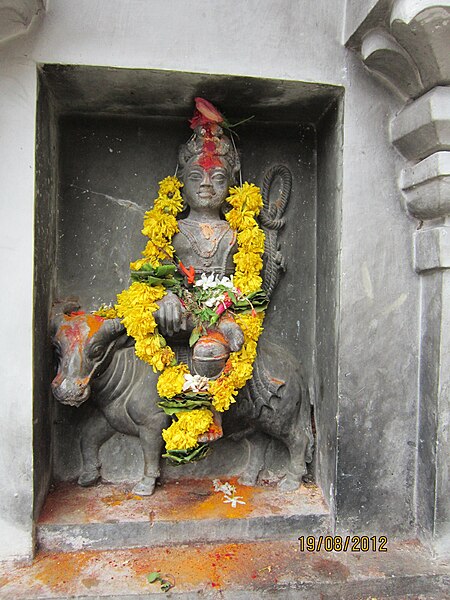
File:God yama statue.JPG
(God yama statue, wikimedia commons)

Tuesday, September 27, 2016

Reading Notes: PDE Mahabharata Part D

There’s so much conflict here and we really don’t see a ton of variation in styles for whatever reason. The general format we see here is very matter of fact and almost historical sounding, which makes the piece have a certain weight to it, but it can weaken the strength of some of the more intense and emotional scenes like when Bhishma finally falls. I think I’d want to really play up the raw emotional aspects of many of these scenes. They’re horrible tragic and they could be done very well. It could be interesting to do a sort of modernized letter (like one sent from the military to a deceased spouse) to alert someone of a family member’s death. It could make for a fun writing project.


I’ll definetly need to include conflict in this week’s piece as there really is just so much of it. We see so many battles and so many horrible tragedies of war. I’d be amiss to not use that kind of beautiful and compelling source material in my writings for this week’s storytelling. The very somber tone that is carried throughout many of the pieces in this reading works very well to express the gravity of what is actually going on. It leaves the reader in a constant state of nervousness and fear waiting for the next tragedy to befall the characters we have no doubt bonded with on some level by now. I hope to be able to emulate that kind of tone if only half as well. It does such a good job of bringing the reader in and giving them something to actually care about so they keep reading. It’s a great stylistic tool and I want to try to emulate it. Perhaps the best example of it is in Ghatotkacha.

Bibliography: PDE Mahabharata, link

File:Death of Drona.jpg
(Death of Drona, wikimedia commons)

Monday, September 26, 2016

Reading Notes: Public Domain Mahabharata Part C

It’s very interesting to see how many parallels there are between the Mahabharata and the Ramayana. Many of the same tropes and themes pop up throughout and this is probably true of most ancient stories that probably originally were passed through oral tradition. I do wonder is there is any actual crossover of the pieces in the originals or if it is just due to the effects of oral tradition but I guess there’s no way to know for sure. We see some small connections throughout for sure, though.

The tale definitely takes on a more epic and arduous format here. The journey through the forest is a very universal archetype that shows up time and time again in literature. Here we see the Pandavas wandering in the forest and as almost always happens with this archetype, they further develop themselves and their minds.

Once again, the gods play a very important role in helping out our characters. Both the god of the sun and Krishna make appearances very early on and promise their assistance. It’s something I’m really not used to seeing in literature and much of my storytelling for this class has essentially avoided it or tried to lower the role of the fantastic but I’m thinking I may want to try to include a little more in the future. I don’t want to make it too strong, but it’s certainly worth trying to include. If I were to revise my latest piece, I would consider adding a more divine aspect to it. I think it could really change the nature of the piece.


It’s interesting to see how some of the pieces are almost comical in nature while many of them are very serious and dark. I’m not sure if it has to do with the various authors involved in the public domain edition or if this is actually in the original, but it’s very interesting none the less. 

Bibliography: Public Domain Mahabharata, link


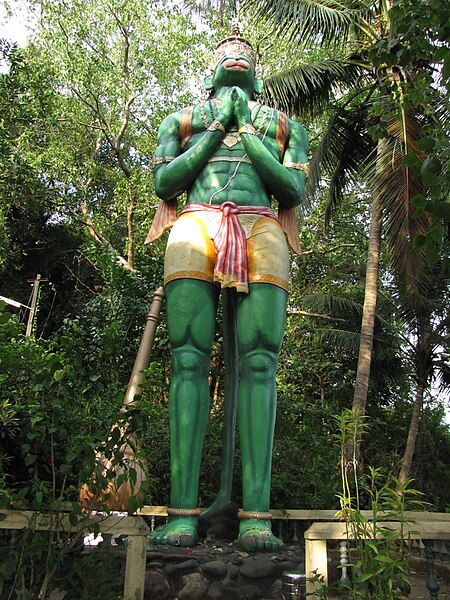
File:Hanuman statue.JPG
(Hanuman statue, Wikimidia Commons)

Wednesday, September 21, 2016

Story: The Lacquer Palace

The Lacquer Palace

            The Pandavas had been invited to stay in The Lac Palace, but expecting an evil plot, Vidura, half-brother of Pandu, father of the Pandavas, warned Prince Yudhishthira of what was to come.
"I fear you are in great danger," he said. "Make sure to move with caution as you proceed."
Prince Yudhishthira thanked Vidura and went on his way, worried about what was to come.

            When the Pandavas and Queen Kunti reached the palace, they marveled at the beauty of it, but Prince Yudhishthira saw that all the great tapestries and beautiful ornate rugs and furniture with wondrous scrollwork were all soaked heavily in something thick and black which reeked of strong alcohol and oil and thus he grew fearful. He warned his brothers and mother, Queen Kunti of what was happening around them and they too feared for their lives but no one knew how to escape for the palace was being watched and guarded.

            Now Prince Vidura still worried about the Pandavas and he had sent a worker of his to infiltrate the stores of oil and alcohol which were to have been used to soak the furniture and walls of the palace and to replace them with a watery tar that could easily be mistaken for oil but would neutralize the flammable liquids already in place. But the worker had made a mistake and instead of replacing the oil and alcohol with tar, he replaced it with a strong brown liquor that was foul to smell. The barrels of liquor had been a gift from a country far away called Ireland but all those who tried it had deemed it unpleasant to taste and instead many people had begun to use it for fuel for it burned quite well. It was also used as glue as it became thick like molasses if left to sit in the sun and it was completely inedible to all human beings except for those who made it.

            When the worker returned to Vidura and saw that the barrels of tar with which he was to replace the oil and alcohol were still there, he panicked and realized what he had just done. Vidura, immediately scolded the worker and sent him to save the Pandavas in another way. The worker dressed up as a woman and tried to seduce the leader of the guards, Purochana and his men who were watching the palace and waiting for a chance to burn it down, but he could not sway them and thus he was forced to try to come up with other methods in order to save the Pandavas. He was unable to come up with a bribe large enough to sway them as well and thus he grew desperate. He finally started digging and digging and digging, trying desperately to dig a tunnel into the palace. But he did not know where he was going when he was underground and he dug for many days, praying that the palace would not burn before he got there, but through a stroke of luck, he managed to reach the palace and accidentally knock free a group of tiles in the center of the palace where Prince Yudhishthira was sitting.

            That very night, the Pandavas snuck out through the tunnel that the worker had built and they went safely into the forest. As they fled, the palace was lit ablaze by the guards that had been watching it and it burned to the ground taking with it a beggar woman and her children who had slept there for the night. The air reeked of molasses as the thick tar-like alcohol burned the building down. When the fires ceased and the bodies were found, it was assumed that these were the bodies of the Pandavas and they were able to slip safely into the forests where they would stay for some time.

Author's note: I think I've done an okay job of making this piece more comic. I just decided to leave the comedy light in this one. The main change obviously is that the worker becomes the main protagonist of the story and through his blundering failures, only barely manages to accidentally save the Pandavas and Queen Kunti. I wanted to take on this story from a less historical-style point and also add some humor to it. Though it isn't an extremely comical piece still, it still has some comic elements which I think are the highlight of it. When I went back to edit this, I didn't end up making a ton of changes and I'm still not happy with this one. Well I just don't think I'm ever going to be particularly happy with this one. I could never really decide where to take it so I left the strange disconnected form as it is. It's not great but I just want to be done with it to move on to other pieces now.

Bibliography: Public Domain Mahabharata, link

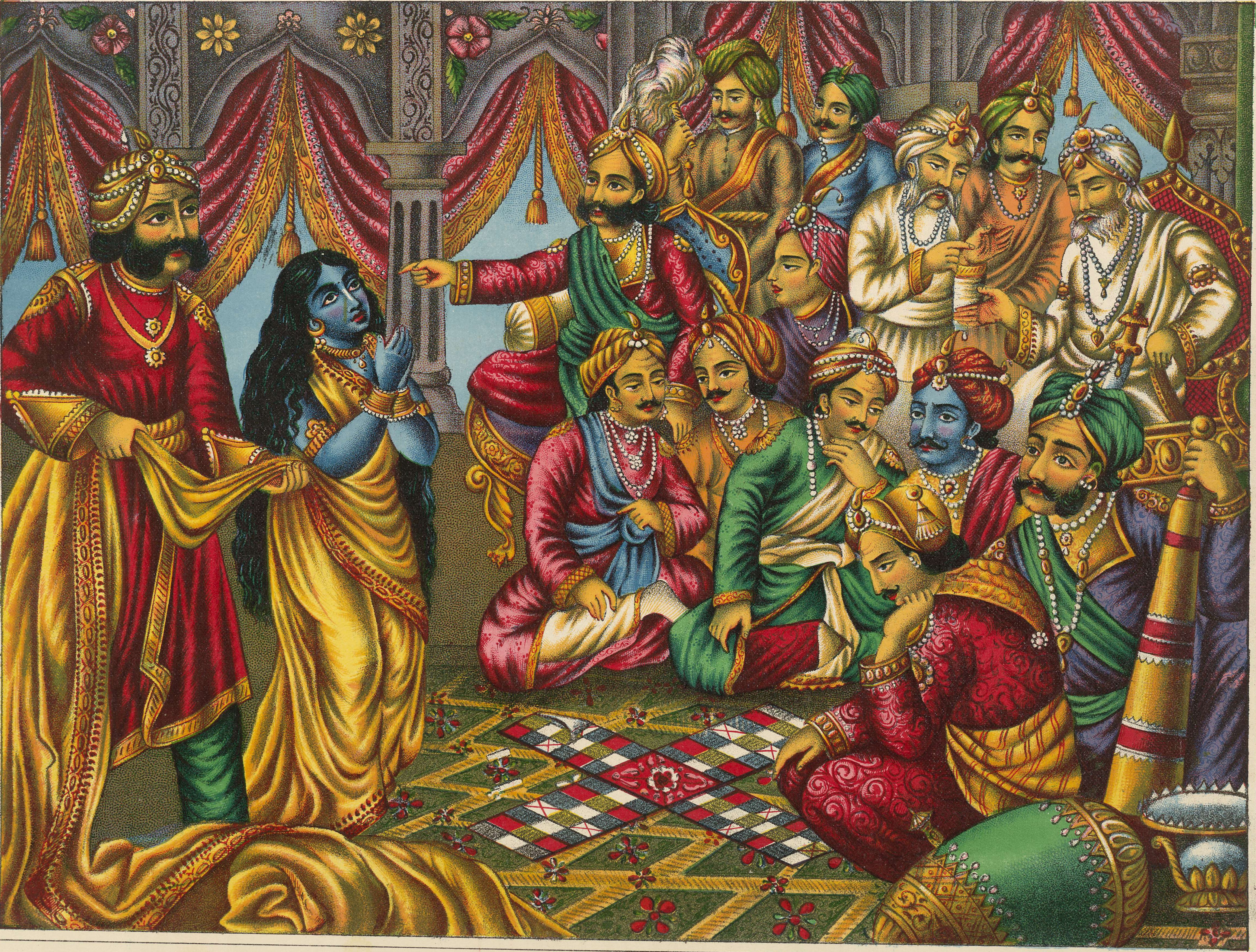
File:Draupadi s presented to a pachisi game.jpg
(Draupadi s presented to a pachisi game, link)

Tuesday, September 20, 2016

Reading Notes: Public Domain Mahabharata Reading Part B

I’m not sure why but the reading this time around seems much harder to follow. Like it’s either denser or maybe it’s just that we’re being constantly introduced to new characters very quickly and there’s a high amount of changeover with each new scene. It’s leading me to certainly have to read and re-read the pieces in order to get the full jist of the material and I keep having to check the Wikipedia links again and again to stay on task with who is who and why people/things are important. It’s gotten a bit dense. From just a pure writing perspective, it’s good from a more objective stylistic point of view but to a modern reader, it’s almost too historical. I definitely think I’ll take a more narrative tone and style during this week’s storytelling. While the historical style can appeal to some because it feels truer to the piece, I feel like I’ll want to take a more modern stylistic approach and that would be more in line with my writings already anyway.


Thematically, I’ve been drawn to the sort of ambivalent and more random nature that life plays with people. It comes up time and time again that the characters in these tales befall misfortune beyond their control. The beggars at the lac palace are burned to death while sleeping. It’s definitely something I want to try to emulate. I want my story this week to really play up the unpredictability of life (and this is even in a world with gods that directly interact with it). If I choose to use gods in my stories, I want to make sure that even they can fall victim to mistakes and chance. I find it very interesting how the story often portrays the gods as distinctly human in their faults. It’s very interesting.

Bibliography: PDE Mahabharata Link

File:Escape of Pandavas from Fire accident.jpg
(Escape of Pandavas from Fire accident, Wikimedia commons)

Monday, September 19, 2016

Reading notes: Public Domain Mahabharata Part A

Just as when I read the Ramayana for the first time, I’m finding myself having to make ample use of the Wikipedia links that give explanations about various character, people, gods, things, etc to get a full understanding of what’s going on. We again see plenty of fantastical elements. Almost immediately we get that some sperm spilled into a river and a fish ate it, resulting in two children. It’s interesting to look into that line of thought because it would seem to imply a belief that children were purely the result of the male sexual organs. I don’t know enough about historical Indian cultural belief to really tell if this is a really belief or not. It is interesting still though.

I do find it very interesting how the god’s in these stories can often be swayed by both good and evil characters so long as they perform certain actions which are looked at in a positive light by the gods. It’s a very interesting aspect to these stories because so often in western culture, we view the idea of a god or gods as being a noble thing generally seeking good. It reminds me of the older western gods like the Roman or Greek ones where the gods themselves are somewhat more fallible and human in nature. They can be tricked and fall victim to many of the same woes as humans. It’s interesting how the gods themselves are often tricking one another and squabbling or battling over things just as humans in the stories might.


Seeing the sorts of major cultural distinctions different from the ones I know is pretty fascinating. It’s very interesting watching the wives of Pandu debate over which one of them will be able to throw themselves on the funeral pyre. It seems almost ridiculous to an outsider like me but I can see that there is a strong cultural meaning behind it.

Bibliography: Public Domain Mahabharata, link

File:Gandhari reprimands Duryodhana.jpg
(Gandhari reprimands Duryodhana, Wikimedia Commons)

Sunday, September 18, 2016

Feedback Focus: Week 4

So I’ve tried these three ways of reading with the goal of providing more insightful feedback and personally I think that reading aloud is definitely the best option when possible. It helps you notice little things that might sound off that you may not have noticed when just reading it on the page. If there’s some phrasing that screws up the flow, you notice it immediately, or if there’s a misplaced word, it sticks out like a sore thumb when you’re reading aloud.

I’m not a huge fan of the timer method in general. It feels a bit too formulaic and doesn’t allow as much space for creativity or changes in materials. Sometimes I find that I’ll spend more time with a material than another to really feel like I have the same level of understanding. The same goes for feedback. Sometimes I spend longer to say less or sometimes I spend a very short time saying quite a bit. The flow can vary quite a bit in either case. This method can be nice in some ways because it gives you some strict guidelines to follow and helps you stay on take but it just lacks the needed creative variance that good feedback has.

The copy and delete method just seemed odd to me. I guess it could help some people by reducing the influence of formatting, but I haven’t really had that problem. Overall, it seemed like a pretty lackluster method for me personally.

The biggest reading technique I use is trying to read with an editor’s eye – ask what could make this piece better? When you’re reading the piece to try and understand it from the writer’s perspective so that you can best understand it, you can give really good feedback to help the author improve their piece.

Image result for editing
(Editing, flickr)