Showing posts with label Story. Show all posts

Wednesday, November 30, 2016

Story: The Bumbling God Finale

And so Krishna had aged and the demons had all but given up hope of ending the man's life. There was no hope of bringing him down for luck was always on his side. No matter what had been sent at him the boy has survived untouched for his entire life. Despite being frail to behold, weak, and sickly, he had made it into adulthood through all the trials and tribulations of his life.

Kamsa had grown extremely frustrated over the years for no matter what he tried, his attempts to end Krishna's life had failed. It seemed there was no hope. Still, Kamsa hoped that either the prophecy had been wrong or that he would find a way to end Krishna's life and prevent the prophecy from occurring. All the the times Krishna had survived against all odds led Kamsa to believe the prophecy was true though and the boy was only being kept alive so that he could fufill the prophecy. Kamsa had one final plan. He sent his soldiers far and wide to find someone that looked exactly as he did. The goal was to have Krishna kill the lookalike and thus the prophecy could perhaps be fulfilled.

An older man who looked like Kamsa was found and brought to the palace and dressed in royal Garb and Kamsa himself dressed as a lowly servant and served his lookalike, but secretly he still gave orders through whispers to his soldiers and servants. Kamsa had his lookalike issue a great proclamation throughout the land that summoned the man known as Krishna to the palace and great wealth was promised to whomsoever was able to get Krishna to the palace. It was Kamsa's belief that simply escorting the man wouldn't let unnatural luck save the man.

Krishna heard of this proclamation and decided to go himself to claim the great wealth for his family but his mother and father begged him not to go. "It will be your death," they said.
"Fear not, mother and father," Krishan said. "I will be fine. The gods watch out for me." And they let him leave though they mourned in their hearts for their son.

Krishna came to the great palace and he was escorted into the throne room where Kamsa's lookalike was sitting on the throne.
"Krishna, welcome to my palace. I have heard of your abilities and would like to personally challenge you to a duel. If you shall win, you may take my place on the throne." Krishan knew he could not deny the duel or he would simply be killed on the spot and thus he agreed. The date and time was set. The duel was to occur the following morning shortly after sunrise.

Krishna was escorted to a grand room and he was brought expensive foods and drinks but he did not take them. Kamsa had had it all poisoned but again Krishna was saved by luck. He was simply not hungry or thirsty that night.

The next morning came and Krishna was escorted from his room and into a grand arena where Kamsa's lookalike was already waiting in the center in golden armor, carrying a massive sword. Krishna wore only a simple tunic and belt.

"Choose your weapon!" Kamsa shouted and suddenly many slaves ran at Krishna all holding various weapons. They stopped a few feet from him and held them out to him for the man to pick. Krishna was not strong and his deformity meant he couldn't use a bow or arrow well and so he took a simple wooden spear. He did not expect to win this fight but he was prepared to die. He had lived a good life and survived against great odds to get so far. It was time. The slaves retreated back to their hidden corners and the two men stood in the arena. Suddenly, a great horn sounded and the battle began. Kamsa charged forward towards Krishna but Krishna did not flee. He lifted the spear up and took aim, prepared to launch it into his enemy. Kamsa grew closer and closer until he was almost on top of Krishna. Krishna let loose the spear and it flew straight but it completely missed Kamsa and soared far past him, impaling a single servant hiding against the outer wall. All the servants and soldiers shouted for it had been the real Kamsa that had been struck. The lookalike stopped just short of cutting Krishna down and he saw where the king lay dead. He dropped his sword and fell to his knees in front Krishna, the new king. And thus, the prophecy was fulfilled.

Authors Note: I wanted to finally end this series before I finished this class and so I put together this ending. I tried to make it seem like Krishna would finally die in this one but then there's the big surprise ending to tie everything up. It probably could have used a bit more information at the ending but I'm satisfied with it for the most part. I hope you enjoyed!

Bibliography: Epified Krishna, link

File:Avatars of Vishnu.jpg
(Avatars of Vishnu, wikimedia commons)

Wednesday, November 16, 2016

Story Planning: The Bumbling God series

So I have decided I actually want to put some more planning into my next piece in the series that I’ve been writing. They’ve gotten very repetitive and personally, I would say that has made them very predictable and quite stale so I wanted to take this week to really plan out what I wanted to do with this series now.

            For those that are new to this piece, the idea of this series is that Krishna is actually a frail, sickly child who only survives due to blind luck rather than godly powers. I’ve based this on the original narrative I found in the Epified version of “Krishna”.

            My original idea was to finally kill Krishna off but that seemed too on the head and a very satisfying ending for this work so thought maybe I should put him in a situation where he actually suffers and doesn’t get magically saved. I’m ultimately leaning to this idea but I’m still not certain how this piece needs to end. The style has been fairly macabre for the most part and I don’t want to mess that up with a suddenly extremely dark or upbeat piece. I’ll probably leave the style untouched this time and focus mainly on changing up what actually happens in this story.


Character development has been pretty weak so far and so I think I want to really flesh out Krishna as a character for once. In most the stories so far stuff happens to him instead of him doing something. I’m going to try to change this up so he is actually the actor. I think having him actually cause something to change in the world will actually make the whole series more enjoyable and give more weight to his character as well. This is the biggest change I want to make. He needs to be more substantive in the work.

Bibliography: epified Krishna, link


File:Bodleian Library Indian paintings MS. Douce Or. a.3 fol30r.jpg
(Bodleian Library Indian paintings, wikimedia commons)

Wednesday, November 9, 2016

Story: The Bumbling God Part 4

Krishna continued to live as a young man in the forest with the others of his former village. But he was not ever completely safe. Demons were constantly hunting for him but his location was never found for one key reason. Whenever a demon found him, the demon would somehow die before it could relate that information to the others like it. This happened so often that it become a bit of a great threat within the community of demons. They all spoke that if you entered the forest, you would be struck dead. None of them knew why though for everyone who went died.

Finally the demons heard what was happening. They pretended to be regular humans and they listened to the stories of the people that lived in the forest and the people spoke of a man who was immune to the threat of demons. Finally the boy had been found. The demons prepared a great force to send against him in order to finally end him. They assumed he must have been some kind of great warrior unlike any other that had lived before since he defeated so many demons already at such a young age. They armed themselves and prepared in great numbers for their assault. They assumed many of their kind would fall in the attack but they continued with their work.

The day of the attack came. The boy was known to be fishing out on the ocean and he would be an easy target. He wouldn’t have whatever powerful weapons he was using to fight the demons in the past, they assumed. Several of the demons took the form of fish and began swimming looking for the boat with the boy that had to be Krishna. The demons spotted a boat with two people on it - a sickly young man and a brawny, strong figure working with him. The demons did not know that the stronger man was Krishna’s cousin and not Krishna himself. The demons returned to the others like them and informed them that they had found the boy. The demos swarmed across the ocean, taking the form of giant serpents and great sea monsters. They rapidly approached the boat and the two young men on the boat spotted the horrible onslaught and grew horribly fearful for their lives and they ducked down and hid under their nets.

Just as the demons were about to fall on the boat and kill the two young men, suddenly a great storm swept up, sending fierce waves that crushed the demons. The boys assumed the monsters had seized the boat as it swayed viciously in the storm, but after several hours of horrible tossing, the boat stopped and sat in still waters. They had survived and the entire demon army had been killed in the storm. The boy Krishna had lived again. The rumors grew fierce that there was a boy who no one could harm and this word spread far and wide reaching a certain king with a certain grudge against the boy.

Author's note: I have continued the series that I started a few weeks ago and I'm still having fun with it. This is one of the few that I wrote completely from scratch without basing it on a specific story or instance in the epified piece. I had fun with it and though it's gotten a bit predictable, I think I'm going to spice it up in the next few iterations.

Bibliography: Epified Krishna, link

File:Death of Krishna - Illustrations from the Barddhaman edition of Mahabharata.jpg
(Death of Krishna, wikimedia commons)

Wednesday, November 2, 2016

Story: The Bumbling God Part 3

The Bumbling God Part 3

As Krishna continued his life in the village, many of the villagers suddenly began to have dreams which urged them to leave the city and as these dreams continued for many nights, the families and people of the village finally packed up and moved. They wandered into a nearby forest where they decided to make their home. In this place, Krishna and his friends would play among the trees making music with flutes and other homemade instruments. They would do this every day, making beautiful and lighthearted music to raise the spirits of the forest. What they did not know was that there was a lake nearby that was home to an evil snake demon and the demon’s very presence made the water poisonous not only to drink but simply to the touch. If you even got any of the water on you, it would kill you within a few short minutes.
            One day Krishna was playing his flute in the woods and he suddenly realized that he didn’t hear the sounds of his friends singing or playing their instruments and so he wandered around looking for them. He found the poison lake surrounded by his dead friends. He fell to his knees and cried for them but suddenly a great snake sprang forth from the lake and rose into the air with the clear intent to eat Krishna. Krishna could not run very fast due to his clubfoot and so he was unable to flee and instead stared directly at the beast. It reared up and then sprang at him with its mouth wide open, prepared to eat the boy. All Krishna could think to do was throw his flute at the creature and he closed his eyes, lobbed the flute, and waited for death. But death did not come for him. He heard a horrible grinding sound and an angry roar and he opened his eyes to the sight of the snake with the flute stuck in its jaws forcing its mouth completely open so that it could not close its mouth. It writhed in agony clearly in pain but confused at what was preventing it from closing its mouth. Krishna hobbled away trying to get to the nearby trees where he could hide. The monster spotted him out of the corner of its eye and it tried to give chase but its vision was hampered by its open mouth and so it struggled to follow the boy. It glimpsed him out of the corner of its eye and lunged again with all its might but instead of hitting the boy, the snake found a tree and drove the flute into its brain, killing itself.

            This great commotion brought other villagers towards the sounds and when they found the boy Krishna next to the dead snake, they could not believe what had happened for clearly a boy with so many physical impairments could not defeat such a demon. The villagers found Krishna’s flute in the creature’s skull though and they came to believe that the boy had killed the snake even though he insisted he had not. He was too humble they said of him. The people would come to think of him as an avatar of one of the gods for no mere mortal would have such luck.

Author's Note: I've decided to continue this series I started two weeks ago. For those new to this piece, basically the idea is that Krishna in this story is still a god but only survives and succeeds through basically random chance. He's deformed and a little bit slow and somehow still always survives through something random happening. In the original source material, Krishna uses his divine powers to simply overcome the beast but here we see he simply lucks out completely but because he is so lucky, people begin to think he is something special. I got the idea for this series of stories mainly because in so many Indian tales that I've read for this class, the characters are all essentially godlike. When they have faults, they're often still fatal but they're still so far above regualr individuals that it made all the stories seem a bit too fantastical. I guess I'm kind of poking fun at it with a bit a flipped take. Now I have a character that is in no way fantastic. In fact, he's a bit slow and still he's able to survive essentially anything thrown at him, not through his won great abilities but because he is very lucky. If you liked this one, check out the others in the series!

bibliography: Epified Krishna, link

File:Avatars of Vishnu.jpg
(Krishna statue, wikimedia commons)

Wednesday, October 26, 2016

Story: The Bumbling God Part 2

The Bumbling God Part 2

The baby Krishna came to grow up in a village not to far from the palace in which he was born. Kamsa had given up hope of finding the child with his own men but he was still anxious for and worried for the prophecy could still come to end his life and thus he had sent demons to find the boy and kill him. As Krishna grew up he became known as something of a trickster among the villagers. This was not entirely his fault though as he often accidentally inconvenienced others. 
Krishna was considered a massive troublemaker but few knew that it was not his intention to ever inconvenience others. It was his curse. Because one of his legs was longer than the other, he had an odd gait that led him to often walk in odd patterns instead of in a straight line. When his mind would drift while he walked, he would often bump into women who were carrying jars filled with milk or butter and thus Krishna was known as the one who spills milk and butter among the people of the village even though he had never tried to spill their milk or butter. The women whose milk had been spilled would go to Krishna’s mother and explain what the boy had done but his mother would always defend him.
“It is not his fault,” she would say. “The boy’s mind simply wanders and he doesn’t see you sometimes.” The other women would begrudgingly accept this and go on their way. Now the young Krishna was still being hunted but he did not know what to fear. The boy was still young and very naïve and while he was walking through the village one day, a woman bumped into him and she spilled the milk she was carrying all over the ground. Krishna apologized and offered to make reparations but the woman said she was fine. She simply asked for Krishna to help her carry the pieces of her jar home so it could be mended with clay. The boy helped her back to her home but once she was there, she thanked him for the help and offered him a cup of water. Krishna did not want to be rude and so he stepped towards the woman to take the cup, but he tripped over his foot and caused the woman to spill the water on herself. She screamed in agony and writhed on the floor as the water burned her flesh. Krishna did not know what was happening and so he fled from the house back to his home. He didn’t know that the woman was a demon who had been planning on poisoning the young Krishna, but when the poison was spilled on her instead, it had poisoned her and ended her life.

Kamsa learned quickly from other demons that the first assassin he had sent had failed to kill the boy and thus he was determined to send others to make sure the job was finished this next time.

Bibliography: Epified Krishna, link

File:Krishna's great escape Bazaar art,1940's.jpg
(Krishna's great escape, wikimedia commons)

Wednesday, October 19, 2016

Storytelling: The Bumbling God

The Bumbling God


And so it had been prophesied that the great king Kamsa would be laid low by the eighth child of his sister. Fearful of this prophecy, the great king had his sister and her husband imprisoned and each time she would bear a child, he would come into the room, take it from her and her husband, and kill it by smashing it against the cell wall. This continued many times over many years with his sister mourning in agony each time her child was taken from her.
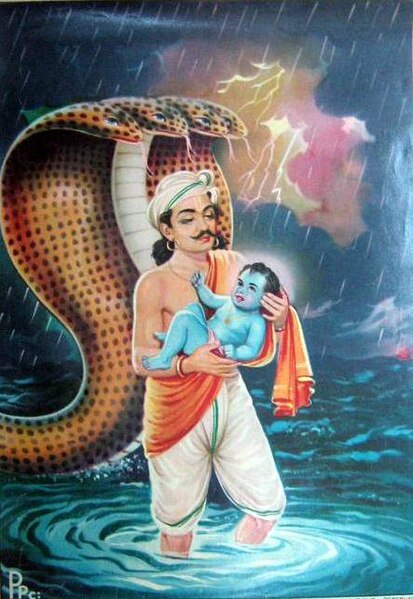
            Finally, the time came when her eighth child was to be born. It was late at night and Kamsa was sleeping in his bed while the child came into the world. When the child was born, his mother and father looked him over and were forlorn for he was deformed and frail. His skin was fragile and tore easily, one of his legs was longer than the other, and his eyes were filled with thick clouds. They mourned for their poor child and his frailness. His mother named him Krishna.
            In the morning, Kamsa was informed by his men that the eighth child (the one that he had been warned of) had been born and so he went into the cell to finally kill this child and thus give himself immortality, but what he found did not frighten him. Instead, he was humored by what he found. “This child will never harm me. This child could never harm anyone except by accident perhaps. It will be lucky to survive a month on its own, It is sickly to look at. It poses no threat to me or anyone” he said and left laughing, feeling that the prophecy must have been wrong. There was no way such a weak and deformed child was going to pose any threat to him.
            After several days passed, Kamsa decided to free his sister and her husband, letting them return to their homes. “You pose no threat to me anymore” he said, sending them away from his palace with nothing but the clothes they wore. They wandered for most of the day, crossing a great bridge to reach a small village on the other side. There, they stopped and rested for the night.
            That very night, though, Kamsa had a nightmare that a great horror had befallen him and ended his life. He woke up terrified and called his soldiers, sending them forth into the nearby villages to slaughter the children that lived there. The child had to die. He had made a mistake. And so his soldiers went forth, killing hundreds of babies, but they did not go far enough to reach the village where the baby Krishna was hidden. It was too late and he had slipped through the king's mighty grasp.
            Kamsa felt tentatively safe, assuming the child had been found and killed, but he was never certain and for many months, he slept nervously, afraid of what he didn’t know. He had always known to trust the prophecies and he cursed himself for not simply killing the child when he had had the chance to do so. Now, there was no way to be certain if the child was still alive. He ordered his soldiers to search for his sister and her husband, but no matter how hard they looked, they could not find the couple or the child. Kamsa was left in a state of constant worry, unsure of what to do in order to try to save his life. He summoned mercenaries and demons alike and offered them great wealth if they could find his sister and her husband and slay the child that was with them. They all accepted and spread out across the countryside to hunt down the child.


Authors note: So I tried something new with this. I decided to write a story that’s going to be a part of a series. I will continue this story for the next few weeks. The idea here is that Krishna will grow up through the stories and survive constant deadly trials purely out of luck. He will be a bit of a bumbling and sickly idiot who is somehow saved through pure luck. The story isn't really laced with humor which I had originally intended. In fact, it's kind of dark and it's an interesting take on the constant role of divinity in these tales. I decided to turn it all on its head and have an important character who is only saved through constant luck. Krishna in this tale isn't powerful or imposing to look at. In this story, he's frail and sickly and it's a wonder he hasn't died of natural causes on his own yet let alone died from the people and things intentionally out to get him. This kind of fits in with the other absurd pieces I've put in my portfolio and I've been adding another chapter to this story every week since I wrote this piece so stay tuned and check out the future pieces.


Bibliography: Epified Krishna, link

File:Krishna's great escape Bazaar art,1940's.jpg
(Krishna's great escape, wikimedia commons)

Wednesday, October 5, 2016

Story: Yes, Mother

Yes, Mother

The Pandava brothers had walked into their mother’s room excited to tell their her their good news but when they found her, she was tired and absentminded and as they told her that they had obtained something fantastic, she simply told them “Well make sure you share it between all of you so I don’t have to hear you complain when one of you tries to hog it for himsefl.” The brothers looked at one another nervously, no one brother wanting to be the one to tell their mother what she had just told them to do. Finally, after several seconds had passed the brothers simply slunk away without saying anything else. Their mother paid them no mind, thinking them as just being strange as usual.
And so they sat in the courtyard discussing what was to be done. “We can’t all marry the same woman. We’re not Mormons, here,” One brother joked and they all laughed. Yet still none of them really knew what to do. They all knew their mother was prone to anger and they had known that if they had laughed at her, she would have been very angry at them and so they instead sat around thinking about how to tell their mother. It seemed like it should be a simple thing but they made it something greater amongst themselves and kept arguing. At first, it had been planned that only one of them, the eldest was to go on a date with this girl. They had all met at a county fair where one brother, Drupada, had caught her attention by winning several games of darts in a row. She had sat with all the brothers and they had all vied for her, and they had returned home each planning to find a way of making her his own.
“I was the one who caught her attention and so I really deserve to be the one dating her,” Drupada said. But his brothers all disagreed for various reasons and tried to make their own points about why each of them was the actually deserving one. This went on for several hours with no progress being made.
“Look, we’re getting nowhere,” Drupada said. “We need to start suggesting solutions instead of just stating why each of us is the best for her. It’s not going to get us any further than this. Why don’t we have a competition of sorts?”
“Riddles,” one brother said.
“No way. Arm-wrestling is the only fair way,” another argued.
“That’s not fair. You’ll win. It has to be fair for everyone or else it isn’t worth doing,” yet another argued.

“Why don’t we let her decide?” Drupada said. The others asked him to explain himself. “Well you see, we can invite her out to something with all of us and then we will simply observe who she ends up choosing by the end of the night.” And thus it was agreed that they would all go on a group date in order to decide how they should proceed from there. But there were still more surprises to come.

Authors note: I wanted to do a modernized re-write of this tale but I was worried that if I used the stories names too much, it would make things seem out of place or out of time. In the end, the lack of names probably gets a bit confusing so I may end up re-writing it again and just modernizing the names. I tried to leave it open ended in case I decide to write a follow-up to it.


Bibliography: Wife of the Five Pandavas, Public Domain Mahabharata, link


File:Draupadi and Pandavas.jpg
(Draupadi and Pandavas, wikimedia commons)

Wednesday, September 28, 2016

Story: The Mechanical Monster

The Mechanical Monster

In that twelfth year, when the Pandava brethren were to finally return home from their long and arduous exile, they were beset by one of the greatest challenges they would face yet. And so it happened that a white deer had stolen the kindling of a well known Brahmin and this Brahmin had begged the Pandavas to aid him and finally Yudhishthira acquiesced and promised their aid. And so they had gone forth into the forest to hunt the deer, but no matter how hard the Pandavas tried and no matter how carefully their traps were hidden or how true their aim was, they failed to capture the beast. In their exhaustion, they rested in the middle of great forest under a leafy canopy that blocked out almost all light from the sun. One of them by the name of Nakula climbed a tree to look for a water source so that they could drink and continue their quest. Spotting a clear, blue lake, he quickly descended the tree and sprinted to the water but he was stopped by a giant metal monster that came in front of him and shouted, “You must answer my question before you can drink.” Nakula did not listen though and attempted to drink from the lake and the great mechanical beast rolled forward and with long, rope-like arms so fast they could not be seen, he snatched up Nakula and then was gone in a puff of smoke.
            One after the other, those that had journeyed forth to find the deer came to the pond and they were confronted by the great mechanical beast who demanded that each one answer his questions. Never did they listen though and soon four brothers had been snatched away by the great monster. Finally,  Yudhishthira came forth and the beast spoke to him. “You must answer my question before you shall drink.”
            “Speak then, but first I must ask you, why do you do this? I have seen you take the others and I know what you plan to do to me as well if I do not humor you,” Yudhishthira said.
            “Don't ask me silly questions
I won't play silly games
I'm just a simple choo choo train
And I'll always be the same.
I only want to race along
Beneath the bright blue sky
And be a happy choo choo train
Until the day I die.”
“I do not understand you, great beast,” Yudhishthira said.
“It does not matter,” the beast said. “There is a thing that nothing is, and yet it has a name. It's sometimes tall and sometimes short, joins our talks, joins our sport, and plays at every game.”
“It is a shadow,” Yudhishthira said.
“Right. Now you ask me one,” the beast said.
“But you said if I answered your question, you would leave me be. If I answer your questions, will you free my brothers?”
“Your brothers are dead and so soon you shall be too. Ask me a riddle or I shall end you.”
“Fine. What's better than all the gods and worse than Old Man Splitfoot. Dead people eat it always; live people who eat it die slowly?”
“Nothing, of course,” the beast said quickly as if it wasn't even a challenge. “Today he is there to trip you up and he will torture you tomorrow. Yet he is also there to ease the pain, when you are lost in grief and sorrow.”
“Alcohol,” Yudhishthira said. "You hear it speak, for it has a hard tongue. But it cannot breathe, for it has not a lung. What is it?"
"A bell," the beast said.
 And so it went on in this order with one giving a riddle and another answering it immediately with neither one having to think for even a moment about what the answer was. This continued for several days and nights with the two never stopping and never stumping the other. Finally, a little boy wandered into the verbal struggle and by the beast noticed him immediately. It rolled up to him and it demanded “Tell me a riddle, child!” The child was not at all frightened though and then asked the beast, “Why did the chicken cross the road?” And the beast was silent. It did not know the answer to this question. It thought hard and from deep inside its metal body, a great grinding sound split the air. Then it went completely silent for a several minutes.
            “I don’t know. What?” the beast said.
            “To get to the other side!” And the beast roared and prepared to harm the child, but in the time that it was distracted by the child, Yudhishthira  pulled off the wheels of the beast and he found his brothers stored in a cage in the back part of the beast's body. The beast was unable to move and howled loudly as it had been beaten. The brothers drank from the water and went from that place in peace.

Author's note: I originally had wanted to keep this piece in the historical setting but very quickly had a good idea that involved riddles from one of my favorite book series out there: The Dark Tower series by Stephen King. This specific idea is taken from The Wastelands. I took the train from those books and I used him as the one asking the riddles instead of the original character in this story. For those that don't know, the train is a big fan of riddles in the story and becomes a major antagonist by asking them so it made sense to me to put him in a piece like this. It was a fun little blend to write and it probably would have been fun to make it a bit longer, but for a class like this, It's better to just leave the piece shorter and maybe write another addition later related to this instead. Ultimately, I felt that having the train asking riddles fit the story really well because both the original source material in the Mahabharata and the piece by Stephen King have difficult challenges for their respective protagonists involving riddles. The riddles also help to draw the reader in because they're are always fun to read  and that definitely gives the reader some intrigue so they aren't just bored with the story. In my revisions, I actually left most of the content the same and decided to focus most of my changes on the little details of the piece. I added more descriptions, more colors and visuals so that the reader can better center themselves in the piece. I intentionally left the train vague still because it makes the build up much better for the reader. 

Bibliography: PDE Mahabharata, link,    The Wastelands By Stephen King


File:God yama statue.JPG
(God yama statue, wikimedia commons)

Wednesday, September 21, 2016

Story: The Lacquer Palace

The Lacquer Palace

            The Pandavas had been invited to stay in The Lac Palace, but expecting an evil plot, Vidura, half-brother of Pandu, father of the Pandavas, warned Prince Yudhishthira of what was to come.
"I fear you are in great danger," he said. "Make sure to move with caution as you proceed."
Prince Yudhishthira thanked Vidura and went on his way, worried about what was to come.

            When the Pandavas and Queen Kunti reached the palace, they marveled at the beauty of it, but Prince Yudhishthira saw that all the great tapestries and beautiful ornate rugs and furniture with wondrous scrollwork were all soaked heavily in something thick and black which reeked of strong alcohol and oil and thus he grew fearful. He warned his brothers and mother, Queen Kunti of what was happening around them and they too feared for their lives but no one knew how to escape for the palace was being watched and guarded.

            Now Prince Vidura still worried about the Pandavas and he had sent a worker of his to infiltrate the stores of oil and alcohol which were to have been used to soak the furniture and walls of the palace and to replace them with a watery tar that could easily be mistaken for oil but would neutralize the flammable liquids already in place. But the worker had made a mistake and instead of replacing the oil and alcohol with tar, he replaced it with a strong brown liquor that was foul to smell. The barrels of liquor had been a gift from a country far away called Ireland but all those who tried it had deemed it unpleasant to taste and instead many people had begun to use it for fuel for it burned quite well. It was also used as glue as it became thick like molasses if left to sit in the sun and it was completely inedible to all human beings except for those who made it.

            When the worker returned to Vidura and saw that the barrels of tar with which he was to replace the oil and alcohol were still there, he panicked and realized what he had just done. Vidura, immediately scolded the worker and sent him to save the Pandavas in another way. The worker dressed up as a woman and tried to seduce the leader of the guards, Purochana and his men who were watching the palace and waiting for a chance to burn it down, but he could not sway them and thus he was forced to try to come up with other methods in order to save the Pandavas. He was unable to come up with a bribe large enough to sway them as well and thus he grew desperate. He finally started digging and digging and digging, trying desperately to dig a tunnel into the palace. But he did not know where he was going when he was underground and he dug for many days, praying that the palace would not burn before he got there, but through a stroke of luck, he managed to reach the palace and accidentally knock free a group of tiles in the center of the palace where Prince Yudhishthira was sitting.

            That very night, the Pandavas snuck out through the tunnel that the worker had built and they went safely into the forest. As they fled, the palace was lit ablaze by the guards that had been watching it and it burned to the ground taking with it a beggar woman and her children who had slept there for the night. The air reeked of molasses as the thick tar-like alcohol burned the building down. When the fires ceased and the bodies were found, it was assumed that these were the bodies of the Pandavas and they were able to slip safely into the forests where they would stay for some time.

Author's note: I think I've done an okay job of making this piece more comic. I just decided to leave the comedy light in this one. The main change obviously is that the worker becomes the main protagonist of the story and through his blundering failures, only barely manages to accidentally save the Pandavas and Queen Kunti. I wanted to take on this story from a less historical-style point and also add some humor to it. Though it isn't an extremely comical piece still, it still has some comic elements which I think are the highlight of it. When I went back to edit this, I didn't end up making a ton of changes and I'm still not happy with this one. Well I just don't think I'm ever going to be particularly happy with this one. I could never really decide where to take it so I left the strange disconnected form as it is. It's not great but I just want to be done with it to move on to other pieces now.

Bibliography: Public Domain Mahabharata, link

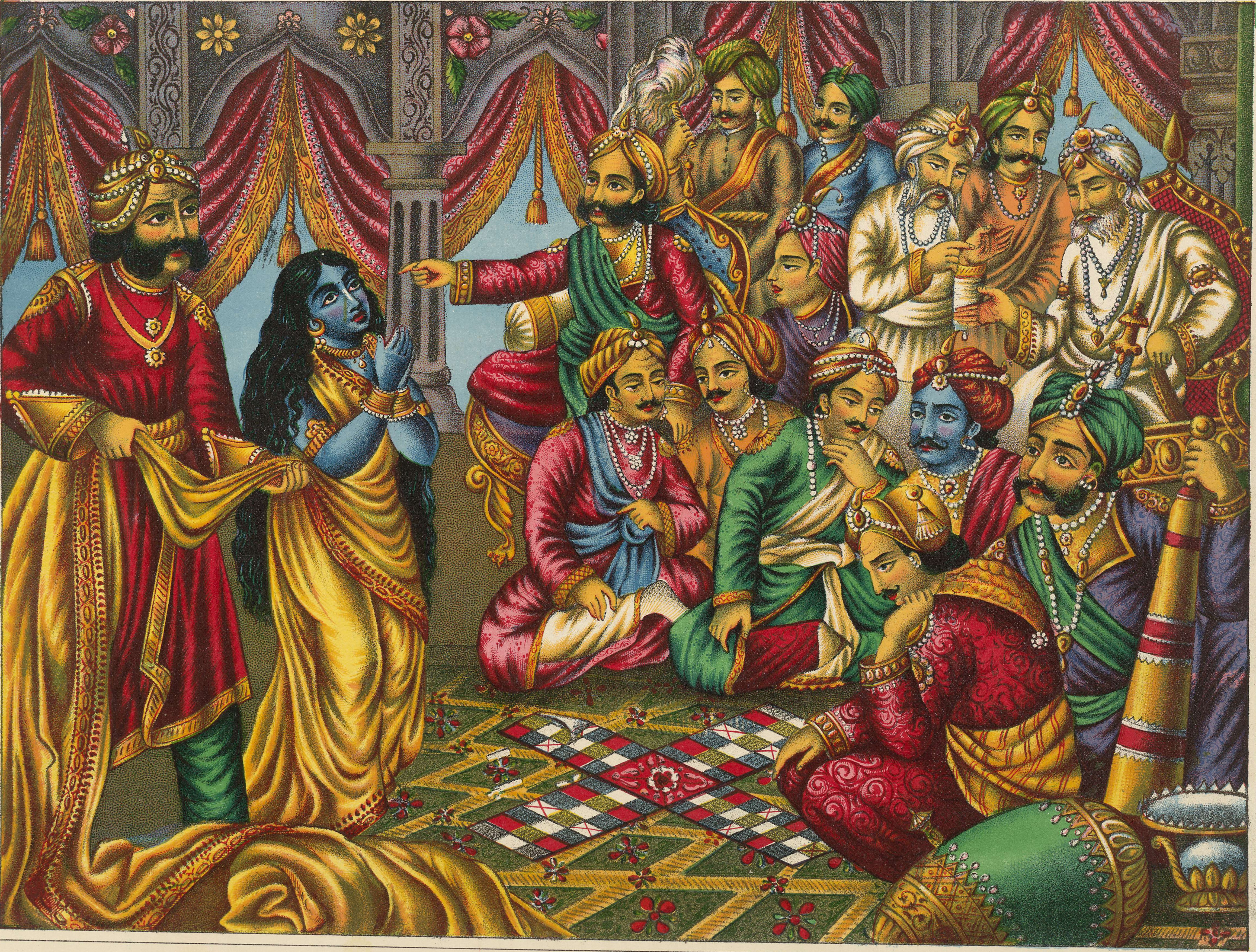
File:Draupadi s presented to a pachisi game.jpg
(Draupadi s presented to a pachisi game, link)

Wednesday, September 14, 2016

Story: Rama and Sita

Rama and Sita

Rama stepped down the steps off the jet, his brother Lakshmana chasing behind him and their guide in this city, Vishvamitra leading the way to the Limo. Rama had been sent by his father to help finalize a deal for Vishvamitra’s company. Vishvamitra had gone to Rama’s father to ask for help and since he knew Rama was quickly becoming well known in the business world, he beseeched Rama’s father to send his son to help. Rama’s father was hesitant at first and asked if he could send someone else but Vishvamitra insisted and so Rama’s father acquiesced after Rama himself told his father he was willing to go. This exchange was overheard by Rama’s brother, Lakshmana who asked if he could go as well to gain experience and both Rama and their father were fine with it.

The trio of the brothers and their current guide climbed into the limousine, which drove them deep into the center of the city of Mithila and parked in front of the skyscraper where their meeting was to take place. The brothers were led by Vishvamitra into the building and up the elevator to the 55th floor and into a conference room where the president of the other company, Janaka was waiting for them with two of his assistants.

The discussion started quickly with charts being presented and little details being debated, but Rama smiled through the whole exchange and Janaka grew fond of him very quickly. The two discussed the finer details of the aforementioned business deal and Rama was able to convince Janaka to accept the original terms that Vishvamitra had proposed. After the deal was finalized and the documents signed, Rama and Lakshmana asked Vishvamitra if they could wander around the city a bit and Vishvamitra said that would be no problem. He offered them his driver but the brothers insisted on just taking an Uber.

The brothers rode into the center of downtown and after getting out of their ride, they quickly made their way into the garden center, one of the town’s many popular tourist spots. Rama and his brother wandered around the glorious garden’s taking in and observing the many different colorful flowers and arrangements. As the brothers walked around, the others that observed them whispered amongst one another asking who these young men dressed in such expensive suits were.

  While the brothers were looking at a collection of orchids, Rama overheard the voice of a young woman and he found himself almost instantly smitten with just her voice. He turned around and was met with the sight of a beautiful woman dressed in a flowing dress of many colors, accompanied by several other young women. He asked her for her name and she that it was “Sita.”

“Oh Sita, would you please let me take you out this very night,” Rama asked. Sita said that her father, Janaka had to approve of all her suitors before he would allow Sita to go out and so she gave Rama her number and the two separated. The brothers returned back to the hotel where they were to meet Vishvamitra. On the way there, though Rama received a phone call from Sita inviting him to her father’s house to meet him and share a meal. Rama asked if his brother and Vishvamitra could come along and Sita said that was fine. So Rama shared the news with his brother and Vishvamitra and the three of them set forth to visit Sita’s father. Though they did not know it yet, Sita’s father was the very Janaka they had spoken with earlier that day.


Author's note: I've been having fun with modern retellings and so I thought I'd stick with it some more. I took one of the first scenes we find in the Ramayana and tried to superimpose it over some modern events and culture. I left the names of people and places the same for stylistic effect but it kind of seems out of place looking back on it. Oh well. It sticks mostly to the original source material with only a few slight deviations.


Bibliography: Divine Archer, F.J. Gould

File:The breaking of the Bow of Janaka.jpg
(The breaking of the Bow of Janaka, wikimedia commons)

Wednesday, September 7, 2016

Story: Hanuman's Fantastic Leap

Hanuman's Fantastic Leap

And so it came to pass that the band of the monkeys that had set forth to find the missing wife of Rama had reached the great sea that separated the  continent from the evil city of Lanka. Without any way to cross, it was then discussed among the monkeys how they were to cross such an immense ocean. Several monkeys joked that they could easily leap the entire distance of the ocean in a single bound, but then Hanuman (who was always boisterous and a bit foolhardy) boasted that he would leap over the entire length of the sea in one bound. The others did not take him seriously and largely ignored his comment, greatly frustrating him as they continued discussing how they were to cross the sea in more realistic ways.

As the others discussed their plans, Hanuman, dejected and upset, slunk away and attempted to assemble a catapult from the carts and equipment the monkeys had brought with them and he rolled it to the edge of the beach away from the sight of other monkeys. But when he tried to fire it, it split in half for he did not know what he was doing and so he was forced to rework his design and build it again from the scraps. This time, he was able to launch a rock a few feet but again, after several tries, it broke. He toiled tediously building and rebuilding again and again hoping to finish his task before they caught on, but each time he could still see them splash into the ocean and so he would disassemble his machine and rebuild it bigger and stronger each time. Whenever he would fire the machine, he would nervously glance in the direction where the others were still discussing their plans, afraid that they would hear him and come look for themselves what the ruckus was, but each time, no one came to see what Hanuman was up to. It was just assumed he was somewhere breaking things in retaliation for being ignored.This went on throughout the night with Hanuman finally creating an apparatus capable of launching a heavy log far out of sight beyond the edge of the horizon. Contented with himself, he broke for a quick meal, eating several bananas he found on a nearby tree. After he had finished his meal and while the others slept, Hanuman prepared himself a large tarp sewn together from the large leaves of the elephant ear plant of the forest. He planned to use the net he created in order to slow down his descent into Lanka so that he could land safely when he finally reached the other side of the great sea. He was confident that he would make it.

The following morning, the other monkeys went to the beach to see what kinds of ships they could launch from the shores, but they immediately found the giant catapult that Hanuman had built waiting for them. Hanuman himself sat in the basket holding a long stick with which he was trying to use to activate the firing mechanism and thus launch himself across the sea. The others begged Hanuman to stop what he was doing before he hurt himself, but he would not listen to them. The other monkeys rushed forward to try to steal the stick from Hanuman so that he could not fling himself to what was surely his certain doom, but instead they accidentally activated the apparatus and Hanuman was flung far into the sky, rocketing quickly beyond the horizon. The other monkeys mourned for the loss of their good friend now that he was surely dead. “What a fool he was," they said, telling one another that they did everything they could to stop Hanuman from his clearly insane path. They quickly agreed to build boats to cross the water in hopes that they might be able to recover the body of their foolish friend.

While the monkeys wailed for the death of their friend, Hanuman himself calmly soared through the air high above the water at extreme speed. He could see the fish swimming below him in the clear, blue waters and his eye was caught by a dark black spot on the ocean’s surface that continued to grow bigger and bigger below him. He watched it, curious, as it was moving right along below him matching his speed perfectly and thus Hanuman assumed this must be his shadow until suddenly, the black dot, which had by then grown extremely large in size, burst apart at the surface of the sea and now from that same spot, a large shark sped through the air towards Hanuman with its gaping maw open and gnashing. Hanuman panicked in the air and he flung his arms wildly trying to move out of the way of the shark. He shook so wildly that he almost let loose the tarp that he had tied tightly to his back with ropes. The shark did not reach Hanuman though, falling several meters short, and it fell back into the sea below with a massive splash. It did not again try to reach Hanuman but the monkey kept watching nervously waiting for such an attempt. The rest of his flight went peacefully.

As Hanuman neared Lanka, he observed thousands of towers and buildings that made up the great city. He prepared himself both mentally and physically for what was to come. He was to invade the city and save Sita all before the other monkeys even knew he was there. Then they'd finally appreciate his work. Hanuman released his great tarp to slow himself down so that he could land safely but instead he slammed into the side of a tower and died.

Bibliography: Public Domain Ramayana, Hanuman's Leap

Author's Note: I wanted to try to remove some of the explicit magical elements found in one of the stories we've read so I decided to make a more humorous and more realistic (though still pretty ridiculous) retelling of Hanuman's leap. The main change is that I simply eliminated the role of magical qualities (other than the talking monkeys). There's no super powers. There's no climbing mountains in minutes. The only absurd part is the catapult itself which at least is a real thing even if the events that happen with it are a bit far-fetched. I tried to keep up some of the absurdity and the ending really plays into that since it completely violates the original ending and would basically ruin the entire rest of the Ramayana without some heavy narrative rework. This whole story is kind of a twist on the absurdity of what's often happening in the Ramayana. The reader knows what's happening is insane and so it's puzzling when suddenly things are realistic once again. It was a fun little experiment.
I've tried to revise this story to make many aspects of this story clearer and I really tried to make the comedic elements a little more blunt. I think the story is more pleasant to read if the comedic style and tone are maintained. Originally I had wanted the piece to be more matter-of-fact but I think the story is much more pleasing to read when it's left to be a little more comic. By changing some of the more serious parts to reflect that, it makes the overall piece both more stylistically uniform and a more enjoyable read for the audience. The absurdity makes it a much stronger piece overall, I think.

File:Hanuman and Surasa.jpg
/(Hanuman and Surasa, wikimedia commons)

Wednesday, August 31, 2016

Story: Bradley and Ramon


Bradley and Ramon


Heat rippled off the ground in long, thin tendrils, bending and waving through the light like smoke. It’d been hot the whole summer as it always was in the deep south of Makom, Texas. It was about thirty miles south of Dallas. It was the sort of small suburb you found outside every big city in America.

Bradley was the youngest of three brothers and still lived with his parents. Bradley’s mom was not the mother to either of his brother and neither of his brothers shared the same mother either. Bradley’s father, Damien, hadn’t had the most success with marriage in the past given this was his third try and though this one had lasted the longest, it was going downhill. Bradley’s mother, Maria, had met Bradley’s father in the hospital where she was working as a nurse. His dad had wound up in the emergency room after getting bitten by a rattle snake while moving logs. The two had ended up dating for a few months afterward and then Maria got pregnant with Bradley and the two got married quickly after finding out. Such was the tradition in towns like Makom.

Bradley’s brothers Ramon and Larry had always been kind to him through childhood. The three got along very well despite having different mothers. They grew up fast, always excelling in their classes. As they came into young adulthood, they worked for their father’s construction company, impressing others with their great knowledge and strength for their age, but Ramon was the strongest and smartest, and yet Bradley and Larry didn’t envy him for it. The three all respected one another.

Near Ramon’s 18th birthday, his father was growing ill and told his wife and Ramon that if he passed he wanted Ramon to take over the business. Ramon was young but Damien insisted that the workers respected him and would listen to him. Maria did not like this arrangement though for one of her coworkers’ sons had just been promoted to VP at the bank where he worked. As Damien lay in bed resting late at night, Maria came to him and said

“Do you remember on our wedding night when you promised me anything in the world you could provide in exchange for me saving your life that one time?”

“I do,” Damien said.

“I beg you to please let Bradley manage the company when you pass. He greatly deserves it,” Maria pleased.

“What? I cannot do such a thing. Bradley will not even be 18 for two more years. He isn’t even ready if I wanted to put him in charge,” Damien said.

“Please. If you don’t do this, I’ll kill myself too. Please wait for Bradley to take charge. Send Ramon to travel the world for a few years. He is smart and will do well. That way, he will be ready for the world and will find his own job somewhere with his great skillset. Then, Bradley will be old enough to take power long before Ramon returns. If you were to pass, I could manage the company until Bradley was old enough. “

“No. I cannot betray my son that way. Bradley wishes to and deserves my position. It is only fair to give it to him.”

“But you promised me this! You must!”

“Please don’t make me do this!”

But the wife could not be swayed and the father gave in. The next morning, he told Ramon and Larry of what had transpired. Larry rejected the decision immediately but Ramon silenced him and said,

“It’s okay, dad.”

Larry promised to go with Ramon. If Ramon was to leave, then Larry would go with him. Ramon and Larry packed their things and went on their way, while their father mourned for their leaving. All this while, Bradley was still in class during the day and when he returned that night, his mother told him what had transpired.

“You can’t be serious. My brothers are gone! And it’s because of you! I don’t even want to be in charge. I want to go to college. How could you do this?” Bradley shouted.


“I did what I did for you!” Bradley’s mother pleaded, but Bradley would not listen. He grabbed his things and began running to the bus station to catch his brothers and stop them.


File:Bharata meets Rama in Chitrakoot.jpg
(Bharata meets Rama in Chitrakoot, wikimedia commons)

Authors Note: I based this story on parts 21-23 of reading B. I tried to do a modern retelling of the tale because it seemed like an interesting challenge. I changed the names up a bit and had to change some events to make them make more sense and even then some of it was a stretch, but it was a fun exercise. 

Bibliography: Public Domain Ramayana

Monday, August 22, 2016

Story: Old King Cole


“Send in my jesters, three!” the man yelled from his throne.
The small door at the end of the hall opened up and in danced three little jesters prancing around in colorful outfits of patchwork purples and greens, occasionally tripping on their long, cloth shoes and giggling madly as they did so.
“What jesters are these?” asked the old man on the throne. “I asked for jesters, three. These are children!”
“Yes, of course,” the younger man standing to the right of the throne said. You asked for jesters, three, so we went and found you three jesters that all happen to be three years old.”
“This is ridiculous!” Old King Cole shouted.
“No it’s what you asked for.” The prince said.
“Well what can they do?” Asked the king.
“Not much. They’re three.”
“I KNOW there are three of them!” The king roared.
“No, I meant they’re three years old,” the young man said.
“I’m going to slap you,” the king said. The Jesters giggled as they watched. They had all taken seats on the floor and were now playing with the long floppy socks on their feet.
“Well you asked for jesters, three and so we found this troupe of triplet jesters that all happened to be three. It’s exactly what you wanted – to the note.”
“No it isn’t!” the king shouted.
“Well they’re here now,” the prince said.
The three young jesters all watched this exchange, rocking back and forth while they laughed.
“Well then I guess I’ll tolerate them. Jesters, show me what you can do! Come on up here. Stand before me and perform!” The jesters jumped up and skipped over in their colorful little onesies and stood right before the old man and the prince. The jesters all looked at the prince as if waiting for something.
“Well go on,” the prince said.
“Grandpa, do you have Minecraft?” one of the jesters said. The prince coughed and broke out into hysterical laughter.
“No guys, do the_” the prince was too busy laughing to finish his sentence. “Do the little dance and finish the scene, you guys!”
“It’s fine. Come on, kids. Give me a big hug. We’ll try acting another time. You’ll have to learn to appreciate the theatre when you’re older.” The old man rose from the chair and the little kids ran up to embrace him. “Now what the jiminy doo dad is Minecraft?”
“It’s a game they all play. You won’t have it,” the younger man said.
“I have plenty of board games,” the old man said.
“It’s not a board game, dad. You’d think they’d be more interested in acting given their lineage.” A door opened at the end of the room and an older woman leaned in.
“Lunch is ready, you guys,” the woman said. The little jesters jumped up and sprinted for the door.
“Well it was worth a shot. Thanks for trying, dad.”
“Of course. I’ll take any chance I get to play with my grandchildren.” The two men smiled at one another in silence for a brief moment.
“I guess we should join them,” the old man said.

“I guess we should,” the younger man said.


Authors Note: You can obviously tell I've deviated quite a bit from the source material on this one. The original rhyme just talks about a jolly old man and his three fiddlers. I enjoy writing intentional misdirection in  my stories quite a bit and so this story is meant to let the reader feel at first their in some sort of medieval time that might fight the original time of the rhyme. I left the name the "Cole" the same and used three jesters instead of fiddlers as it added more comic effect, I felt. I wrote it to seem as if they're acting out a little play made from the nursery rhyme but the kids don't end up playing along, but in the end, everyone is still happy and jolly just as in the original rhyme.


Bibliography: This story is based on the nursery rhyme "Old King Cole" found in "The Nursery Rhyme Book" edited by Andrew Lang