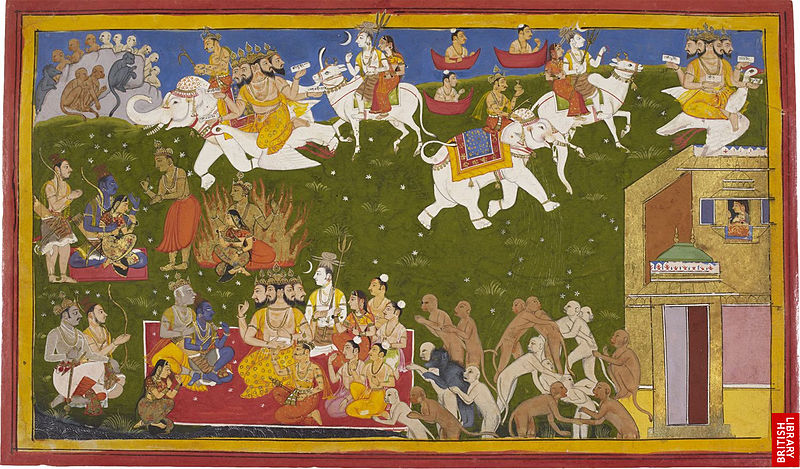
And so it came to pass that the band of the monkeys that had set forth to find the missing wife of Rama had reached the great sea that separated the continent from the evil city of Lanka. Without any way to cross, it was then discussed among the monkeys how they were to cross such an immense ocean. Several monkeys joked that they could easily leap the entire distance of the ocean in a single bound, but then Hanuman (who was always boisterous and a bit foolhardy) boasted that he would leap over the entire length of the sea in one bound. The others did not take him seriously and largely ignored his comment, greatly frustrating him as they continued discussing how they were to cross the sea in more realistic ways.
As the others discussed their plans, Hanuman, dejected and upset, slunk away and attempted to assemble a catapult from the carts and equipment the monkeys had brought with them and he rolled it to the edge of the beach away from the sight of other monkeys. But when he tried to fire it, it split in half for he did not know what he was doing and so he was forced to rework his design and build it again from the scraps. This time, he was able to launch a rock a few feet but again, after several tries, it broke. He toiled tediously building and rebuilding again and again hoping to finish his task before they caught on, but each time he could still see them splash into the ocean and so he would disassemble his machine and rebuild it bigger and stronger each time. Whenever he would fire the machine, he would nervously glance in the direction where the others were still discussing their plans, afraid that they would hear him and come look for themselves what the ruckus was, but each time, no one came to see what Hanuman was up to. It was just assumed he was somewhere breaking things in retaliation for being ignored.This went on throughout the night with Hanuman finally creating an apparatus capable of launching a heavy log far out of sight beyond the edge of the horizon. Contented with himself, he broke for a quick meal, eating several bananas he found on a nearby tree. After he had finished his meal and while the others slept, Hanuman prepared himself a large tarp sewn together from the large leaves of the elephant ear plant of the forest. He planned to use the net he created in order to slow down his descent into Lanka so that he could land safely when he finally reached the other side of the great sea. He was confident that he would make it.
The following morning, the other monkeys went to the beach to see what kinds of ships they could launch from the shores, but they immediately found the giant catapult that Hanuman had built waiting for them. Hanuman himself sat in the basket holding a long stick with which he was trying to use to activate the firing mechanism and thus launch himself across the sea. The others begged Hanuman to stop what he was doing before he hurt himself, but he would not listen to them. The other monkeys rushed forward to try to steal the stick from Hanuman so that he could not fling himself to what was surely his certain doom, but instead they accidentally activated the apparatus and Hanuman was flung far into the sky, rocketing quickly beyond the horizon. The other monkeys mourned for the loss of their good friend now that he was surely dead. “What a fool he was," they said, telling one another that they did everything they could to stop Hanuman from his clearly insane path. They quickly agreed to build boats to cross the water in hopes that they might be able to recover the body of their foolish friend.
While the monkeys wailed for the death of their friend, Hanuman himself calmly soared through the air high above the water at extreme speed. He could see the fish swimming below him in the clear, blue waters and his eye was caught by a dark black spot on the ocean’s surface that continued to grow bigger and bigger below him. He watched it, curious, as it was moving right along below him matching his speed perfectly and thus Hanuman assumed this must be his shadow until suddenly, the black dot, which had by then grown extremely large in size, burst apart at the surface of the sea and now from that same spot, a large shark sped through the air towards Hanuman with its gaping maw open and gnashing. Hanuman panicked in the air and he flung his arms wildly trying to move out of the way of the shark. He shook so wildly that he almost let loose the tarp that he had tied tightly to his back with ropes. The shark did not reach Hanuman though, falling several meters short, and it fell back into the sea below with a massive splash. It did not again try to reach Hanuman but the monkey kept watching nervously waiting for such an attempt. The rest of his flight went peacefully.
As Hanuman neared Lanka, he observed thousands of towers and buildings that made up the great city. He prepared himself both mentally and physically for what was to come. He was to invade the city and save Sita all before the other monkeys even knew he was there. Then they'd finally appreciate his work. Hanuman released his great tarp to slow himself down so that he could land safely but instead he slammed into the side of a tower and died.
Bibliography: Public Domain Ramayana, Hanuman's Leap
Author's Note: I wanted to try to remove some of the explicit magical elements found in one of the stories we've read so I decided to make a more humorous and more realistic (though still pretty ridiculous) retelling of Hanuman's leap. The main change is that I simply eliminated the role of magical qualities (other than the talking monkeys). There's no super powers. There's no climbing mountains in minutes. The only absurd part is the catapult itself which at least is a real thing even if the events that happen with it are a bit far-fetched. I tried to keep up some of the absurdity and the ending really plays into that since it completely violates the original ending and would basically ruin the entire rest of the Ramayana without some heavy narrative rework. This whole story is kind of a twist on the absurdity of what's often happening in the Ramayana. The reader knows what's happening is insane and so it's puzzling when suddenly things are realistic once again. It was a fun little experiment.
I've tried to revise this story to make many aspects of this story clearer and I really tried to make the comedic elements a little more blunt. I think the story is more pleasant to read if the comedic style and tone are maintained. Originally I had wanted the piece to be more matter-of-fact but I think the story is much more pleasing to read when it's left to be a little more comic. By changing some of the more serious parts to reflect that, it makes the overall piece both more stylistically uniform and a more enjoyable read for the audience. The absurdity makes it a much stronger piece overall, I think.

/(Hanuman and Surasa, wikimedia commons)