The Mechanical
Monster
In that twelfth year, when the Pandava brethren were to finally return home from their long and arduous exile, they were beset by one of the
greatest challenges they would face yet. And so it happened that a white deer had stolen the kindling of a well known Brahmin and this Brahmin had begged the Pandavas to aid
him and finally Yudhishthira acquiesced and promised their aid. And so they had gone forth into the forest to hunt the deer, but no matter
how hard the Pandavas tried and no matter how carefully their traps were hidden or how true their aim was,
they failed to capture the beast. In their exhaustion, they rested in the middle of great forest under a leafy canopy that blocked out almost all light from the sun. One of
them by the name of Nakula climbed a tree to look for a water source so that they could drink and continue their quest. Spotting
a clear, blue lake, he quickly descended the tree and sprinted to the water but he was stopped by a giant metal monster that came in front of him and shouted, “You must answer my question before you can drink.” Nakula did not listen though and attempted to drink from the lake and the
great mechanical beast rolled forward and with long, rope-like arms so fast they could not be seen, he snatched up Nakula and then
was gone in a puff of smoke.
One after
the other, those that had journeyed forth to find the deer came to the pond and
they were confronted by the great mechanical beast who demanded that each one answer
his questions. Never did they listen though and soon four brothers had been snatched away by the great monster. Finally, Yudhishthira
came forth and the beast spoke to him. “You must answer my question before you shall drink.”
“Speak
then, but first I must ask you, why do you do this? I have seen you take the others and I know what you plan to do to me as well if I do not humor you,” Yudhishthira said.
“Don't ask
me silly questions
I won't play silly games
I'm just a simple choo choo train
And I'll always be the same.
I only want to race along
Beneath the bright blue sky
And be a happy choo choo train
Until the day I die.”
“I do not understand you, great
beast,” Yudhishthira said.
“It does not matter,” the beast
said. “There is a thing that nothing is, and yet it has a name. It's sometimes
tall and sometimes short, joins our talks, joins our sport, and plays at every
game.”
“It is a shadow,” Yudhishthira
said.
“Right. Now you ask me one,” the
beast said.
“But you said if I answered your
question, you would leave me be. If I answer your questions, will you free
my brothers?”
“Your brothers are dead and so soon you shall be too. Ask me a riddle or I shall end you.”
“Fine. What's better than all the
gods and worse than Old Man Splitfoot. Dead people eat it always; live people
who eat it die slowly?”
“Nothing, of course,” the beast
said quickly as if it wasn't even a challenge. “Today he is there to trip you up and he will torture you tomorrow. Yet
he is also there to ease the pain, when you are lost in grief and sorrow.”
“Alcohol,” Yudhishthira
said. "You hear it speak, for it has a hard tongue. But it cannot breathe, for it has not a lung. What is it?"
"A bell," the beast said.
And so it went on in this order with one giving a riddle and another answering it immediately with neither one having to think for even a moment about what the answer was. This continued for several days and nights with the two never stopping and never stumping the other. Finally, a little boy wandered into the verbal struggle and by the beast noticed him immediately. It rolled up to him and it demanded “Tell me a riddle, child!” The child was not at all frightened though and then asked the beast, “Why did the chicken cross the road?” And the beast was silent. It did not know the answer to this question. It thought hard and from deep inside its metal body, a great grinding sound split the air. Then it went completely silent for a several minutes.
"A bell," the beast said.
And so it went on in this order with one giving a riddle and another answering it immediately with neither one having to think for even a moment about what the answer was. This continued for several days and nights with the two never stopping and never stumping the other. Finally, a little boy wandered into the verbal struggle and by the beast noticed him immediately. It rolled up to him and it demanded “Tell me a riddle, child!” The child was not at all frightened though and then asked the beast, “Why did the chicken cross the road?” And the beast was silent. It did not know the answer to this question. It thought hard and from deep inside its metal body, a great grinding sound split the air. Then it went completely silent for a several minutes.
“I don’t
know. What?” the beast said.
“To get to
the other side!” And the beast roared and prepared to harm the child, but in the time that it was distracted by the child, Yudhishthira pulled off the wheels of the
beast and he found his brothers stored in a cage in the back part of the beast's body.
The beast was unable to move and howled loudly as it had been beaten. The
brothers drank from the water and went from that place in peace.
Author's note: I originally had wanted to keep this piece in the historical setting but very quickly had a good idea that involved riddles from one of my favorite book series out there: The Dark Tower series by Stephen King. This specific idea is taken from The Wastelands. I took the train from those books and I used him as the one asking the riddles instead of the original character in this story. For those that don't know, the train is a big fan of riddles in the story and becomes a major antagonist by asking them so it made sense to me to put him in a piece like this. It was a fun little blend to write and it probably would have been fun to make it a bit longer, but for a class like this, It's better to just leave the piece shorter and maybe write another addition later related to this instead. Ultimately, I felt that having the train asking riddles fit the story really well because both the original source material in the Mahabharata and the piece by Stephen King have difficult challenges for their respective protagonists involving riddles. The riddles also help to draw the reader in because they're are always fun to read and that definitely gives the reader some intrigue so they aren't just bored with the story. In my revisions, I actually left most of the content the same and decided to focus most of my changes on the little details of the piece. I added more descriptions, more colors and visuals so that the reader can better center themselves in the piece. I intentionally left the train vague still because it makes the build up much better for the reader.
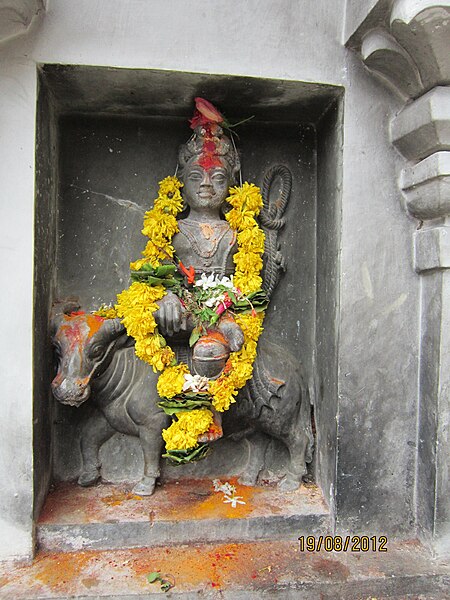
(God yama statue, wikimedia commons)