Monday, October 31, 2016

Reading Notes Week 11: Seven Secrets of Vishnu Part C

So I have decided to continue on with the series The Seven Secrets of Vishnu. Today I watched the videos for part C and was still really intrigued by the material. I found it all very interesting though I still have one major concern with the format. They name-drop in these videos so freaking much that I can never really follow along without having to pause every few seconds and these aren't simple names either - often it's very major new characters being introduced and they're just breezed over as if the viewer is already supposed to know what's going on. It's almost like this is made mostly for people who already know what's being talked about or are at least familiar with the material. I recognize some of the names of people, places, and things that are mentioned but so many of them just breeze by that I'm left feeling out of the loop if I don't pause very often.
Outside of that main concern, I still like this series. You do have to pause often on your own to make sure you understand what's going on and Wikipedia is very important with that but it's doable. It's nice that this material exist even if it isn't done in the most ideal format for an outsider like me. It's still an enjoyable and educational watch.

Bibliography: Seven secrets of Vishnu, link

File:Kurma deva.jpg

Wednesday, October 26, 2016

Story: The Bumbling God Part 2

The Bumbling God Part 2

The baby Krishna came to grow up in a village not to far from the palace in which he was born. Kamsa had given up hope of finding the child with his own men but he was still anxious for and worried for the prophecy could still come to end his life and thus he had sent demons to find the boy and kill him. As Krishna grew up he became known as something of a trickster among the villagers. This was not entirely his fault though as he often accidentally inconvenienced others. 
Krishna was considered a massive troublemaker but few knew that it was not his intention to ever inconvenience others. It was his curse. Because one of his legs was longer than the other, he had an odd gait that led him to often walk in odd patterns instead of in a straight line. When his mind would drift while he walked, he would often bump into women who were carrying jars filled with milk or butter and thus Krishna was known as the one who spills milk and butter among the people of the village even though he had never tried to spill their milk or butter. The women whose milk had been spilled would go to Krishna’s mother and explain what the boy had done but his mother would always defend him.
“It is not his fault,” she would say. “The boy’s mind simply wanders and he doesn’t see you sometimes.” The other women would begrudgingly accept this and go on their way. Now the young Krishna was still being hunted but he did not know what to fear. The boy was still young and very naïve and while he was walking through the village one day, a woman bumped into him and she spilled the milk she was carrying all over the ground. Krishna apologized and offered to make reparations but the woman said she was fine. She simply asked for Krishna to help her carry the pieces of her jar home so it could be mended with clay. The boy helped her back to her home but once she was there, she thanked him for the help and offered him a cup of water. Krishna did not want to be rude and so he stepped towards the woman to take the cup, but he tripped over his foot and caused the woman to spill the water on herself. She screamed in agony and writhed on the floor as the water burned her flesh. Krishna did not know what was happening and so he fled from the house back to his home. He didn’t know that the woman was a demon who had been planning on poisoning the young Krishna, but when the poison was spilled on her instead, it had poisoned her and ended her life.

Kamsa learned quickly from other demons that the first assassin he had sent had failed to kill the boy and thus he was determined to send others to make sure the job was finished this next time.

Bibliography: Epified Krishna, link

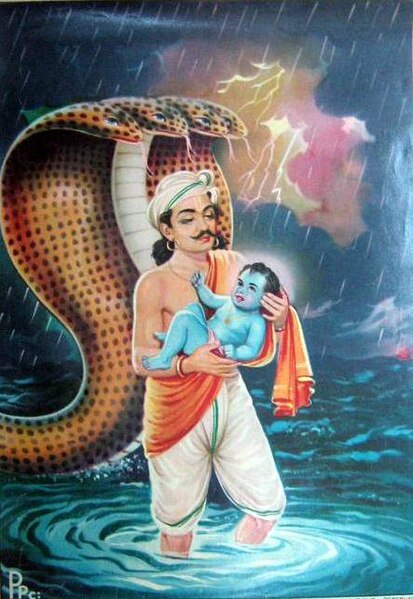
File:Krishna's great escape Bazaar art,1940's.jpg
(Krishna's great escape, wikimedia commons)

Tuesday, October 25, 2016

Reading Notes Week 10: Pattanaik's Secret Secrets of Vishnu: Part B (Matsya)

So I've continued to watch this series on the seven secrets of Vishnu and I have to say it's been pretty enjoyable so far. It's well done, has good production value for what it is, and is extremely informational. I have to echo again just how nice it is to actually get the little details of the history pieces after watching the short Epifed pieces I watched in the past. This is really a breath of fresh air because it actually gives you everything you could ever want to know and more. I love it. I've always been really into history and wanting to know more about something when I heard something. Wikipedia has always been a great resource for that kind of background information but often I find myself digging deeper and deeper into wikipedia and I end up with the philosophy problem - you know the idea that if you spend enough time clicking random links in wikipedia, you'll end up on the page for philosophy. But back to the main material. This day's material covered the secret: "Only humans can empathize and exploit". The material feels very religious in nature - it's that kind of "man is superior to all other beings" kind of thing but is interesting how it is manifested in these pieces for today. The basic idea is that humans are the most superior creature because they have a larger brain and it's postulated that this is modeled in Hinduism with a mark of vishnu on the forehead. The idea is that it's to show that the human brain is something unique in nature. Overall, it was a very enjoyable watch and I think I learned quite a bit from it.

Bibliography: Pattanaik's Secret Secrets of Vishnu: Part B (Matsya) link

File:Matsya avatar.jpg
(Matsya image, wikimedia commons)

Monday, October 24, 2016

Reading Notes: Pattanaik's Secret Secrets of Vishnu: Part A Week 10

So I decided to with another video option because I find them very easy to gain information from with tight time constraints and also because they've generally been a very fun and exciting way to learn the new material. I actually expected this one to be a lot like the epified Mahabharata or the epified Krishna, but I was pleasantly surprised when it was something much deeper in information. It wasn’t just surface information like the epified videos generally were. This video series really digs into the meet of the topic and discusses why each little detail is important. I like how the difference between material reality and spiritual reality is made explicitly clear and the creators go very in depth in explaining the common tropes and metaphors used to represent each. It’s nice to get some background information with the material for once. It’s kind of like the public domain versions of the Ramayana and the Mahabharata. If you remember, those had tons of links that took you to Wikipedia pages that explained all sorts of things that a casual western reader may not understand whether it be a cultural thing or a specific deity or character that is known in Indian mythology but not in western myths. It was a very fun watch and I actually learned quite a bit from these two videos. I’m excited to watch the next ones.

Bibliography: Pattanaik's Secret Secrets of Vishnu, link


File:Mohini Halebid.jpg
(Mohini Statue, wikimedia commons)

Wednesday, October 19, 2016

Storytelling: The Bumbling God

The Bumbling God


And so it had been prophesied that the great king Kamsa would be laid low by the eighth child of his sister. Fearful of this prophecy, the great king had his sister and her husband imprisoned and each time she would bear a child, he would come into the room, take it from her and her husband, and kill it by smashing it against the cell wall. This continued many times over many years with his sister mourning in agony each time her child was taken from her.
            Finally, the time came when her eighth child was to be born. It was late at night and Kamsa was sleeping in his bed while the child came into the world. When the child was born, his mother and father looked him over and were forlorn for he was deformed and frail. His skin was fragile and tore easily, one of his legs was longer than the other, and his eyes were filled with thick clouds. They mourned for their poor child and his frailness. His mother named him Krishna.
            In the morning, Kamsa was informed by his men that the eighth child (the one that he had been warned of) had been born and so he went into the cell to finally kill this child and thus give himself immortality, but what he found did not frighten him. Instead, he was humored by what he found. “This child will never harm me. This child could never harm anyone except by accident perhaps. It will be lucky to survive a month on its own, It is sickly to look at. It poses no threat to me or anyone” he said and left laughing, feeling that the prophecy must have been wrong. There was no way such a weak and deformed child was going to pose any threat to him.
            After several days passed, Kamsa decided to free his sister and her husband, letting them return to their homes. “You pose no threat to me anymore” he said, sending them away from his palace with nothing but the clothes they wore. They wandered for most of the day, crossing a great bridge to reach a small village on the other side. There, they stopped and rested for the night.
            That very night, though, Kamsa had a nightmare that a great horror had befallen him and ended his life. He woke up terrified and called his soldiers, sending them forth into the nearby villages to slaughter the children that lived there. The child had to die. He had made a mistake. And so his soldiers went forth, killing hundreds of babies, but they did not go far enough to reach the village where the baby Krishna was hidden. It was too late and he had slipped through the king's mighty grasp.
            Kamsa felt tentatively safe, assuming the child had been found and killed, but he was never certain and for many months, he slept nervously, afraid of what he didn’t know. He had always known to trust the prophecies and he cursed himself for not simply killing the child when he had had the chance to do so. Now, there was no way to be certain if the child was still alive. He ordered his soldiers to search for his sister and her husband, but no matter how hard they looked, they could not find the couple or the child. Kamsa was left in a state of constant worry, unsure of what to do in order to try to save his life. He summoned mercenaries and demons alike and offered them great wealth if they could find his sister and her husband and slay the child that was with them. They all accepted and spread out across the countryside to hunt down the child.


Authors note: So I tried something new with this. I decided to write a story that’s going to be a part of a series. I will continue this story for the next few weeks. The idea here is that Krishna will grow up through the stories and survive constant deadly trials purely out of luck. He will be a bit of a bumbling and sickly idiot who is somehow saved through pure luck. The story isn't really laced with humor which I had originally intended. In fact, it's kind of dark and it's an interesting take on the constant role of divinity in these tales. I decided to turn it all on its head and have an important character who is only saved through constant luck. Krishna in this tale isn't powerful or imposing to look at. In this story, he's frail and sickly and it's a wonder he hasn't died of natural causes on his own yet let alone died from the people and things intentionally out to get him. This kind of fits in with the other absurd pieces I've put in my portfolio and I've been adding another chapter to this story every week since I wrote this piece so stay tuned and check out the future pieces.


Bibliography: Epified Krishna, link

File:Krishna's great escape Bazaar art,1940's.jpg
(Krishna's great escape, wikimedia commons)

Tuesday, October 18, 2016

Reading Notes Week 9: Epified Krishna Part B

So I’ve continued on with the story of Krishna as done by Epified. It’s a really interesting series and not one that I probably would have found without this class to lead me to it. I first tried the Epified series with the Epified version of the Mahabharata and though at first, I said that the material doesn’t really go into enough depth, I think I’ve come to a more complete conclusion on that. So even though these are very short and don’t give a ton of detail, you can’t really judge them on that scale because they’re not setting out to do that in the first place. They set out to give a cursory overview of the material they’re working with and they do that very well. In some ways, I find the story of Krishna far more interesting just because it’s not as varied and it doesn’t bounce around as much. Personally I felt that the Mahabharta in both the written form and in the Epified version really just bounces around far too much and it makes it very hard to really follow the narrative arcs because there’s constantly new characters and new people being talked about. Now with this story, the narrative is much more focused and targeted around one person and I think this works much better for the Epified format. Instead of telling a bunch of one to three minute stories that only have small connections between them at times, all these stories are very strongly connected. It also feels like the stakes feel higher. From the very beginning of the piece, things have been extremely intense and tumultuous. It really holds the viewer in very well. Finally, I appreciate that the narrators actually have Indian accents because it adds a certain strong cultural tone it that really works well for the piece.

Bibliography: Epified Krishna, link

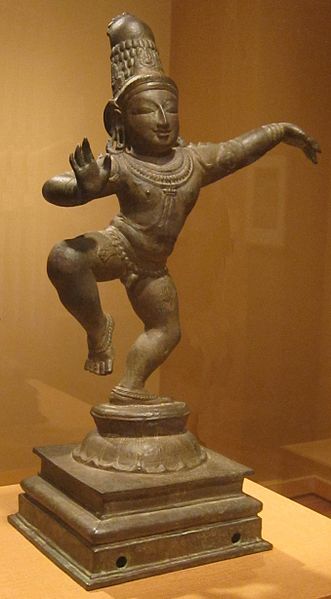
File:Dancing Krishna, India, Tanjore, Tamil Nadu, Chola dynasty, 14th century, bronze, HAA.JPG
(Krishna Statue, wikimedia commons)

Monday, October 17, 2016

Reading notes Week 9: Epified Krishna Part A

I chose to go with the Epified version of Krishna. I made this decision because I really enjoyed the Epified version of the Mahabharta and though I still feel that they don’t give you a ton of information to work with, they do a pretty good job of giving you a basic overview of the material you’re working with. It’s not ideal but it works for the format they’ve chosen. I really do appreciate this kind of format and it makes we wish I had some more artistic skills so that I could pull something off like this. The white board animation is really interesting and it’s even more interesting when you consider that they’re making sure the timeline of the narrations fits the drawn components and I wonder if they speed up or slow down certain drawings in order to fit the narration constraints rather than vice-versa. It certainly seems like that would be the easier of the two options. I guess the other option would just be creating the narration after you’ve done the drawing – so for example, you know it takes three minutes to play the video of the drawing and so you just constrain the narration you write into that three minute block. Either way, it’s an extremely effective and interesting way of presenting material. Even though it’s not the most in-depth, it’s a great way to give outsiders a brief glimpse into the material without being too intensive. I do sometimes struggle to hear all the names they say and this is one area where the written version of the stories really win out. It’s hard to tell who is being described at times unless you’re familiar with many of the names already. Due to my cultural difference, it’s taken a bit longer to catch onto the various names and places.


Bibliography: Epified Krishna, link


File:Sri Mariamman Temple Singapore 2 amk.jpg
(Krishna statue, wikimedia commons)