Wednesday, September 14, 2016

Story: Rama and Sita

Rama and Sita

Rama stepped down the steps off the jet, his brother Lakshmana chasing behind him and their guide in this city, Vishvamitra leading the way to the Limo. Rama had been sent by his father to help finalize a deal for Vishvamitra’s company. Vishvamitra had gone to Rama’s father to ask for help and since he knew Rama was quickly becoming well known in the business world, he beseeched Rama’s father to send his son to help. Rama’s father was hesitant at first and asked if he could send someone else but Vishvamitra insisted and so Rama’s father acquiesced after Rama himself told his father he was willing to go. This exchange was overheard by Rama’s brother, Lakshmana who asked if he could go as well to gain experience and both Rama and their father were fine with it.

The trio of the brothers and their current guide climbed into the limousine, which drove them deep into the center of the city of Mithila and parked in front of the skyscraper where their meeting was to take place. The brothers were led by Vishvamitra into the building and up the elevator to the 55th floor and into a conference room where the president of the other company, Janaka was waiting for them with two of his assistants.

The discussion started quickly with charts being presented and little details being debated, but Rama smiled through the whole exchange and Janaka grew fond of him very quickly. The two discussed the finer details of the aforementioned business deal and Rama was able to convince Janaka to accept the original terms that Vishvamitra had proposed. After the deal was finalized and the documents signed, Rama and Lakshmana asked Vishvamitra if they could wander around the city a bit and Vishvamitra said that would be no problem. He offered them his driver but the brothers insisted on just taking an Uber.

The brothers rode into the center of downtown and after getting out of their ride, they quickly made their way into the garden center, one of the town’s many popular tourist spots. Rama and his brother wandered around the glorious garden’s taking in and observing the many different colorful flowers and arrangements. As the brothers walked around, the others that observed them whispered amongst one another asking who these young men dressed in such expensive suits were.

  While the brothers were looking at a collection of orchids, Rama overheard the voice of a young woman and he found himself almost instantly smitten with just her voice. He turned around and was met with the sight of a beautiful woman dressed in a flowing dress of many colors, accompanied by several other young women. He asked her for her name and she that it was “Sita.”

“Oh Sita, would you please let me take you out this very night,” Rama asked. Sita said that her father, Janaka had to approve of all her suitors before he would allow Sita to go out and so she gave Rama her number and the two separated. The brothers returned back to the hotel where they were to meet Vishvamitra. On the way there, though Rama received a phone call from Sita inviting him to her father’s house to meet him and share a meal. Rama asked if his brother and Vishvamitra could come along and Sita said that was fine. So Rama shared the news with his brother and Vishvamitra and the three of them set forth to visit Sita’s father. Though they did not know it yet, Sita’s father was the very Janaka they had spoken with earlier that day.


Author's note: I've been having fun with modern retellings and so I thought I'd stick with it some more. I took one of the first scenes we find in the Ramayana and tried to superimpose it over some modern events and culture. I left the names of people and places the same for stylistic effect but it kind of seems out of place looking back on it. Oh well. It sticks mostly to the original source material with only a few slight deviations.


Bibliography: Divine Archer, F.J. Gould

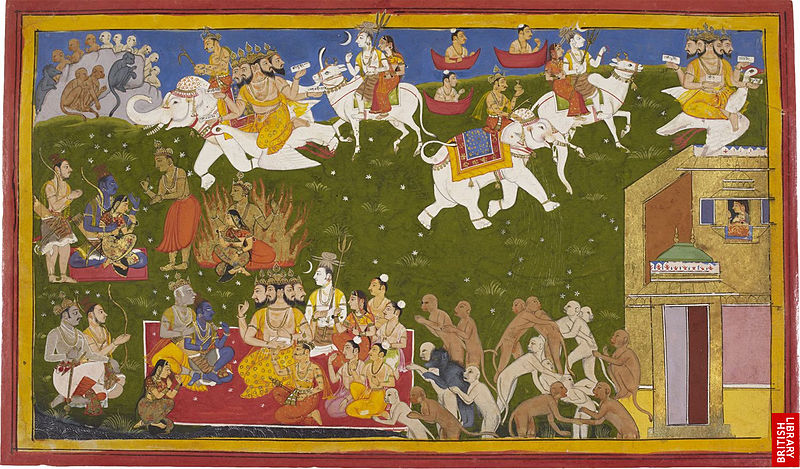
File:The breaking of the Bow of Janaka.jpg
(The breaking of the Bow of Janaka, wikimedia commons)

Tuesday, September 13, 2016

Reading Notes: Divine Archer by F.J. Gould part B

It seems I may have been a bit overzealous with my initial belief that the writing style was much less formal than the public domain edition with its many authors, but after reading this section, I felt like it often grew somewhat matter-of-fact. Intense action scenes are often given without much life to them – they’re simply described. Now there are some battles in the war at Lanka that are described very well but it seems like the majority of the time, a more muted manner of description is taken. It works in a way because it makes it clear that is a translation of an older work. If I were to emulate this kind of style, I’d had to maintain a certain distance as the author and make sure the narrator himself has that same distance from the piece so that the descriptions are more plain and simple. This style has its perks though. It greatly increases the overall believability of the piece because things often don’t need explanation. It’s just stated that Rama does this and thus as the reader, we accept it to be truth. It’s a unique way to force weight behind the written words.


I will say that the style here seems to be based in the idea of storytelling and this makes sense given the context of the Ramayana. There’s a certain beauty to it because it takes a more descriptive and narrative path that still allows for certain embellishments by the actual author and though I’ve struggled to find any major changes made by this author, the stylistic changes alone can actually change the emotion and the tone of a scene. For example, when the great vulture tries to save Sita, the scene in this book is much more emotional than the one found in the public domain edition. Even though the description is from a narrator with some distance, there is still strong emotion in the piece.

Bibliography: Divine Archer by F.J. Gould, link

File:Forest dwelling Rama and Lakshmi battle Ravana..jpg
(Forest dwelling Rama and Lakshmi battle Ravana, Wikimedia commons)

Monday, September 12, 2016

Reading Notes: Divine Archer by F.J. Gould Part A

It’s definitely interesting reading the Ramayana in a different form this time around after first reading it with the public domain version. The scene where Kausalya sees Rama as the baby manifest as a god is particularly well done and beautifully written image. I plan to try to emulate the style you see in that scene with my story this week. The language is very florid and very heavy on imagery and description. It makes for a very visual tale which works very well for tales that may be from another culture such as this to a reader like me.


Though the content is basically the same, this kind of novelized story-telling format of the piece is much more appealing to read than the often more matter-of-fact style used in the public domain edition. It’s much more appealing to the reader this way. I could take a lesson from the style here and make sure to write my stories in a more pleasant to read manner like this one. Though the style isn’t entirely modern, it’s still very easy to read to an outsider like me. There’s lots of small bits of information given throughout the work which helps make things clearer. Like when the Brahmans are described as priests. It’s just a little bit of info that helps give the reader needed info. It’s good form in writing to give the reader that kind of info if they might not know it. There’s definitely a fine line though where you can give too much info to the reader and so you only the most important info should be given. This version of the Ramayana tends to only give the info when a new topic first comes up which is a good way of doing it. When new characters arise, they’re always given sufficient background info to make sure the reader knows what’s going on quickly.

Bibliography: Divine Archer by F.J. Gould, link

File:Parashurama.jpg
(Parashurama, wikimedia commons)

Wednesday, September 7, 2016

Story: Hanuman's Fantastic Leap

Hanuman's Fantastic Leap

And so it came to pass that the band of the monkeys that had set forth to find the missing wife of Rama had reached the great sea that separated the  continent from the evil city of Lanka. Without any way to cross, it was then discussed among the monkeys how they were to cross such an immense ocean. Several monkeys joked that they could easily leap the entire distance of the ocean in a single bound, but then Hanuman (who was always boisterous and a bit foolhardy) boasted that he would leap over the entire length of the sea in one bound. The others did not take him seriously and largely ignored his comment, greatly frustrating him as they continued discussing how they were to cross the sea in more realistic ways.

As the others discussed their plans, Hanuman, dejected and upset, slunk away and attempted to assemble a catapult from the carts and equipment the monkeys had brought with them and he rolled it to the edge of the beach away from the sight of other monkeys. But when he tried to fire it, it split in half for he did not know what he was doing and so he was forced to rework his design and build it again from the scraps. This time, he was able to launch a rock a few feet but again, after several tries, it broke. He toiled tediously building and rebuilding again and again hoping to finish his task before they caught on, but each time he could still see them splash into the ocean and so he would disassemble his machine and rebuild it bigger and stronger each time. Whenever he would fire the machine, he would nervously glance in the direction where the others were still discussing their plans, afraid that they would hear him and come look for themselves what the ruckus was, but each time, no one came to see what Hanuman was up to. It was just assumed he was somewhere breaking things in retaliation for being ignored.This went on throughout the night with Hanuman finally creating an apparatus capable of launching a heavy log far out of sight beyond the edge of the horizon. Contented with himself, he broke for a quick meal, eating several bananas he found on a nearby tree. After he had finished his meal and while the others slept, Hanuman prepared himself a large tarp sewn together from the large leaves of the elephant ear plant of the forest. He planned to use the net he created in order to slow down his descent into Lanka so that he could land safely when he finally reached the other side of the great sea. He was confident that he would make it.

The following morning, the other monkeys went to the beach to see what kinds of ships they could launch from the shores, but they immediately found the giant catapult that Hanuman had built waiting for them. Hanuman himself sat in the basket holding a long stick with which he was trying to use to activate the firing mechanism and thus launch himself across the sea. The others begged Hanuman to stop what he was doing before he hurt himself, but he would not listen to them. The other monkeys rushed forward to try to steal the stick from Hanuman so that he could not fling himself to what was surely his certain doom, but instead they accidentally activated the apparatus and Hanuman was flung far into the sky, rocketing quickly beyond the horizon. The other monkeys mourned for the loss of their good friend now that he was surely dead. “What a fool he was," they said, telling one another that they did everything they could to stop Hanuman from his clearly insane path. They quickly agreed to build boats to cross the water in hopes that they might be able to recover the body of their foolish friend.

While the monkeys wailed for the death of their friend, Hanuman himself calmly soared through the air high above the water at extreme speed. He could see the fish swimming below him in the clear, blue waters and his eye was caught by a dark black spot on the ocean’s surface that continued to grow bigger and bigger below him. He watched it, curious, as it was moving right along below him matching his speed perfectly and thus Hanuman assumed this must be his shadow until suddenly, the black dot, which had by then grown extremely large in size, burst apart at the surface of the sea and now from that same spot, a large shark sped through the air towards Hanuman with its gaping maw open and gnashing. Hanuman panicked in the air and he flung his arms wildly trying to move out of the way of the shark. He shook so wildly that he almost let loose the tarp that he had tied tightly to his back with ropes. The shark did not reach Hanuman though, falling several meters short, and it fell back into the sea below with a massive splash. It did not again try to reach Hanuman but the monkey kept watching nervously waiting for such an attempt. The rest of his flight went peacefully.

As Hanuman neared Lanka, he observed thousands of towers and buildings that made up the great city. He prepared himself both mentally and physically for what was to come. He was to invade the city and save Sita all before the other monkeys even knew he was there. Then they'd finally appreciate his work. Hanuman released his great tarp to slow himself down so that he could land safely but instead he slammed into the side of a tower and died.

Bibliography: Public Domain Ramayana, Hanuman's Leap

Author's Note: I wanted to try to remove some of the explicit magical elements found in one of the stories we've read so I decided to make a more humorous and more realistic (though still pretty ridiculous) retelling of Hanuman's leap. The main change is that I simply eliminated the role of magical qualities (other than the talking monkeys). There's no super powers. There's no climbing mountains in minutes. The only absurd part is the catapult itself which at least is a real thing even if the events that happen with it are a bit far-fetched. I tried to keep up some of the absurdity and the ending really plays into that since it completely violates the original ending and would basically ruin the entire rest of the Ramayana without some heavy narrative rework. This whole story is kind of a twist on the absurdity of what's often happening in the Ramayana. The reader knows what's happening is insane and so it's puzzling when suddenly things are realistic once again. It was a fun little experiment.
I've tried to revise this story to make many aspects of this story clearer and I really tried to make the comedic elements a little more blunt. I think the story is more pleasant to read if the comedic style and tone are maintained. Originally I had wanted the piece to be more matter-of-fact but I think the story is much more pleasing to read when it's left to be a little more comic. By changing some of the more serious parts to reflect that, it makes the overall piece both more stylistically uniform and a more enjoyable read for the audience. The absurdity makes it a much stronger piece overall, I think.

File:Hanuman and Surasa.jpg
/(Hanuman and Surasa, wikimedia commons)

Tuesday, September 6, 2016

Reading Notes: Public Domain Ramayana Part D

They really build up the battle in this set and then even when we get there, it’s a long drawn out process. It is interesting that there are some events that are often almost described in passing. They’re just glossed over briefly and we don’t really get much information while others go very in depth and really become almost novelistic in their form. It’s probably just the result of having many different pieces all written by different authors. Of all the forms though, I definitely prefer the novelistic style and will make sure to emulate the form in my own writing this week. All that said, I really want to try to do a longer battle scene in my story. It’d be fun to just write one long drawn out battle or series of battles that make up a bigger conflict.

It is interesting how magic plays such an integral part of the battles and yet it’s often not the main thing occurring. I mean to say that the battle itself – all the violence, the gore, the fighting – is where the real meat lies but then extremely powerful magic that really do change the tide of things are not as significant. It reminds me of some stories that try to downplay the role of magic because it becomes less of a deus ex machina and it also makes it seem like the characters are just used to the magic and thus the reader also starts to just accept it.


As always we see Rama as this almost indestructible and insurmountable warrior which is very impressive but I honestly wonder what the story would be like if he wasn’t so dang powerful. If he was more human, it’d definitely make the story feel as if he were actually at risk of suffering great harm. It could be fun to write a story where Rama is significantly weaker and has to use his wits and wiles rather than just his incredible strength and power to overcome his obstacles. It would also make the battle scenes much more interesting if you’re looking at how Rama acts in them. 

Bibliography: Public Domain Ramayana, Link


File:Agni Pariksha.jpg
(Agni Pariksha, Wikimedia Commons)

Reading Notes: Public Domain Ramayana Part C

Rama’s seemingly cowardly way of killing Vali is really an interesting twist for a character who has up to now been this extremely noble and indomitable hero. He took on thousands of demons and won and yet now he’s choosing to fight from the shadows. It’s a bit surprising and definitely an interesting writing choice. Keeping promises and fighting nobly face to face seems to have been a pretty big deal up until this point. It’s always a risk in writing when your main character does something that’s seemingly out of character and this is no real exception to that rule. It might be worth trying with my own writing but it’d probably be tricky to do well with just short piece so maybe not.

It’s definitely interesting that it seems like more of the pieces are in verse than before and it makes for a slightly different reading experience than in parts A and B. I’m still hesitant to try writing my own verse form though. Even though it might be good to try, sadly I’ll still probably end up just sticking with prose as I’m more comfortable with it.

I really wanted to comment on Sampati’s story because it seems very similar to the fall of Icarus. Though the motivations are somewhat different and Sampati is injured protecting his brother, it’s still very interesting that the story still has the idea of a character getting too close to the sun and thus being burned. Sampati’s story is very powerful and it would definitely be worth considering to use in my storytelling this week either in theme or perhaps through a retelling.


The sort of amusing way Hanuman gets out of harm’s way is also an almost comic portion of the piece even though it seems like it’s mainly there to show how nimble he is. I could use something similar in storytelling to try to get some light humor going. It’s also interesting how he strikes down a woman to get her out of the way but story makes sure to tell the reader that he was gentle about it which almost seems oxymoronic. I feel like you could retell his little adventure from a rather humorous standpoint and still stay true to the source material.

Bibliography: Public Domain Ramayana, Link

File:The golden abode of King Ravana India.jpg
(The golden abode of King Ravana, wikimedia commons)

Saturday, September 3, 2016

My Feedback Thoughts

I've taken workshop-style creative writing classes at OU and so I've gotten used to both receiving and giving feedback. Like this article says, it's hard to take feedback. We don't like reading about the things we did poorly on. We all want to hear what we've done well. I think the ultimate thing to consider when both giving and receiving feedback is that the goal always be to improve whatever you're giving feedback on. Say what's good and what could be better. Don't just say whether you like it or not. If you do, that's great and let them know that, but you also want to help the other person. That's why you're giving feedback, right? So tell them what you think will help them improve. That's always worked for me and I think it's a very positive way of doing feedback. Both the person receiving feedback and the one giving the feedback are both working towards the same goal and that's when you really get great feedback. You don't want to discourage but you don't want to just give empty praise either.

Grumpy cat meme again by XXspiritwolf2000XX
(Grumpy Cat Meme, Source)